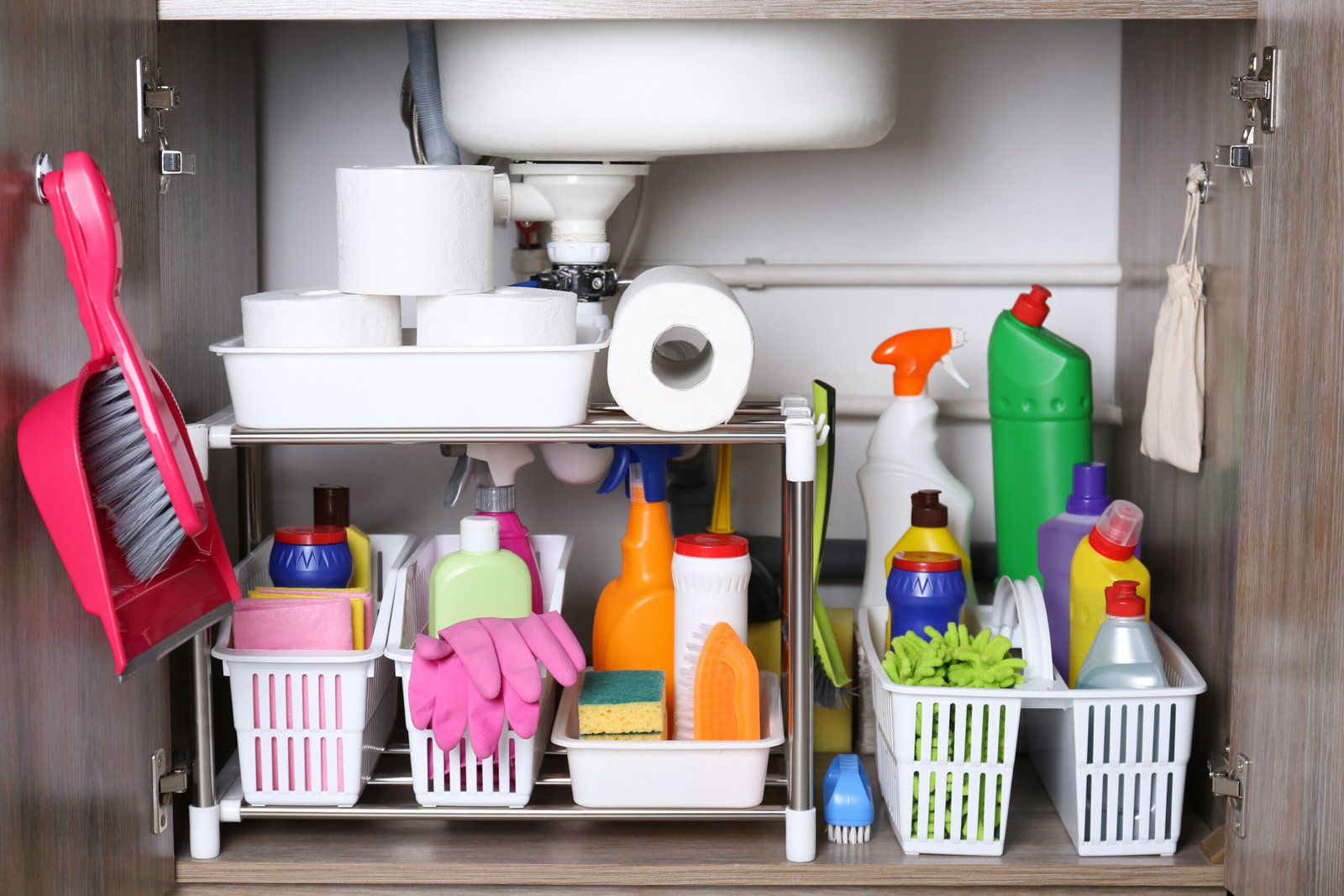
Let’s talk about under-sink storage.
Not the glossy magazine versions with perfectly fitted pull-out drawers, labelled acrylic bins, and plumbing that somehow magically disappears behind custom joinery.
I mean the real cupboard. The one with a chunky 40mm plastic waste pipe dropping down the middle, a P-trap, a random vertical support cutting the space in half, and the hot and cold water feeds sticking out of the floor. The one where cleaning products topple over every time you open the door like a chaotic game of plastic Jenga.
Under-sink cupboards are structurally awkward—and if you are renting or simply don’t want to damage your kitchen units, they are incredibly frustrating.
- You cannot drill shelves into the sides.
- You cannot reroute the plumbing.
- You cannot install heavy-duty metal pull-out tracks.
So, everything ends up piled on the base in a dark, inaccessible heap.
Here is the mindset shift: Good under sink storage ideas without drilling are not about forcing standard, square boxes into a non-square space. They’re about working around the plumbing and building modular structures that adapt to the obstacles.
Here is how to turn the most frustrating cupboard in your home into a functional system.
For a full system across your kitchen, these kitchen storage ideas for renters show how to organise the entire space without drilling.
1. The Geometry Problem (Stop Thinking in Rectangles)
Most people approach under-sink storage like a normal cupboard. They try to fit one large basket or a wide shelf into the space. But under a sink, the space is physically fractured by the plumbing.
The Fix: Think in Modules. Instead of one large container, use multiple small, narrow bins that can slot between the pipes.
- Zone 1 (Left of the pipe): Tall cleaning sprays.
- Zone 2 (Right of the pipe): Sponges, cloths, and dishwasher tablets.
- Zone 3 (The Front Void): The central area right at the front of the cupboard is usually clear of pipes. Keep your most frequently used item (like washing-up liquid) here.
Small, 15cm-wide modules can bypass awkward shapes. Big, 40cm-wide boxes cannot.
2. The 560mm Depth Dilemma (Pull-Out Bins)
A standard UK kitchen base unit has an internal depth of about 560mm. When you put cleaning bottles at the back of a 560mm deep, dark cupboard, they effectively disappear. You have to crouch down, reach blindly past the front bottles, and usually knock three things over in the process.
The Frictionless Fix: Deep, Shallow Pull-Outs. If you cannot drill sliding metal drawers into the base, you can fake the mechanism using deep plastic bins.
- Buy narrow acrylic or plastic bins that are at least 400mm long and feature a front handle.
- Treat the bin like a drawer. When you need the bleach at the back, you slide the entire bin out onto the kitchen floor, pick what you need, and slide it back.
3. The Spray Bottle Hack (Tension Rod Physics)
Spray bottles are architecturally annoying. They are tall, top-heavy, and consume a massive amount of surface area on the base of the cupboard. But they all share one mechanical feature: a trigger.
The Tension Rod Solution: Install a spring-loaded tension rod horizontally across the width of the cupboard, just below the sink basin. You can then hang the spray bottles by their triggers.
Deep Research Tip (Slipping Mechanics): The inside of a modern kitchen cupboard is usually made of MFC (Melamine Faced Chipboard). Melamine is incredibly smooth, meaning the rubber ends of a tension rod often slip when loaded with the weight of four full spray bottles (roughly 2–3kg).
- To fix this: Stick a tiny Command strip or a blob of Blu Tack onto the wall where the tension rod ends meet the melamine. It provides the necessary friction to stop the rod sliding down the wall.
4. Expandable Racks (Bypass the Pipes)
The biggest volume of wasted space is the 30–40cm of empty air hovering above your cleaning products. You cannot screw a solid wooden shelf in because the P-trap blocks the middle of the cupboard.
The Upgrade: Freestanding Under-Sink Racks. These are brilliant, no-drill structural frames.
- They feature an expandable metal frame (so you can adjust the width to fit your specific cupboard).
- The “shelves” are actually individual plastic slats. You simply remove the two or three slats that hit the plumbing pipe, allowing the shelf to wrap neatly around the obstruction.
- This instantly creates a second tier for small items like sponges and bin liners, doubling your storage capacity without a single tool.
5. The Inside Door (Hinge Tolerances)
Like other kitchen cupboards, the inside of the under-sink door is a highly useful vertical surface. However, you must respect the engineering of the hinges. Standard concealed cup hinges will drop and scrape the cabinet frame if you add more than 1.5kg to 2kg of weight to the door.
Strictly Lightweight Storage: Use adhesive hooks or slim plastic caddies for:
- Rubber gloves.
- Microfibre cloths.
- Small scrub brushes.
- A roll of bin bags.
Never hang heavy bottles of surface cleaner on the door. It will ruin the alignment of your kitchen.
6. Material Science (Protecting the MDF Base)
Under the sink is classified as a “Wet Zone.” Plumbers need access, condensation builds on cold water feeds, and bottles occasionally leak.
The Vulnerability of Chipboard: Almost all UK kitchen carcasses are made of chipboard. If a bottle of bleach leaks, or a pipe drips onto the raw joints of the chipboard, the wood will absorb the moisture, swell up, and “blow” (permanently expand and crumble). This is costly damage.
The Prevention:
- No Cardboard: Never store dishwasher tablets in their original cardboard boxes directly on the base. The cardboard will wick up any moisture.
- The Silicone Mat: Buy a flexible, waterproof silicone mat with a raised lip (often sold as under-sink trays). Lay it on the floor of the cupboard. If a leak happens, the tray catches up to 3 litres of water, protecting the cabinetry completely.
If you’re renting, these storage ideas for rented homes cover how to protect surfaces and avoid damage across your space.
7. Stackable Drawers (Avoiding the Pile)
If you have a lot of small, loose items (dishwasher salt, rinse aid, spare sponges, scouring pads), stacking them creates chaos. Clear, stackable acrylic drawers are the best no-drill solution for these items.
- Because the outer casing of the acrylic drawer stays completely stationary, you can pull the internal drawer out without having to unstack the box on top.
- Place these narrow drawer towers on the left or right side of the cupboard, avoiding the central plumbing entirely.
8. The Portable Caddy System
Instead of storing 15 different cleaning products individually, group them by task into a portable plastic caddy with a handle.
- Kitchen Caddy: Surface spray, hob scraper, antibacterial wipes.
- Bathroom Caddy: Bleach, glass cleaner, limescale remover.
Why it works: When it is time to clean the bathroom, you don’t have to carry five individual bottles upstairs. You grab the caddy, do the job, and return the whole unit to the cupboard. It dramatically reduces the visual mess under the sink and saves you time.
9. The 80% Capacity Rule
Under-sink cupboards fail instantly when they are overfilled. If every centimetre is packed with bottles, you physically cannot reach the items at the back without knocking over the items at the front.
Friction vs. Capacity: You must leave a 20% spatial buffer. You should be able to see every single category of item, and remove one bottle without touching another.
If you have too many supplies to allow for this buffer, you need to split the load. Keep the daily-use items under the sink, and move the bulk backups (the 5-litre bottle of floor cleaner, the bulk pack of sponges) to a utility cupboard or a high shelf.
Final Thoughts
Under-sink storage without drilling is not about fighting the architecture of your kitchen. It is about working around the obstacles.
When you shift from trying to “fit things in” to building adaptable, modular layers, the space becomes functional. You hang bottles to clear the base. You use pull-out bins to defeat the depth. You use expandable racks to bypass the pipes.
Start with one simple change: Add a tension rod for your spray bottles. That single adjustment will instantly free up the floor of your cupboard and change how the space works.
1 thought on “Under Sink Storage Ideas Without Drilling (Fix the Most Awkward Space in Your Home)”
Comments are closed.