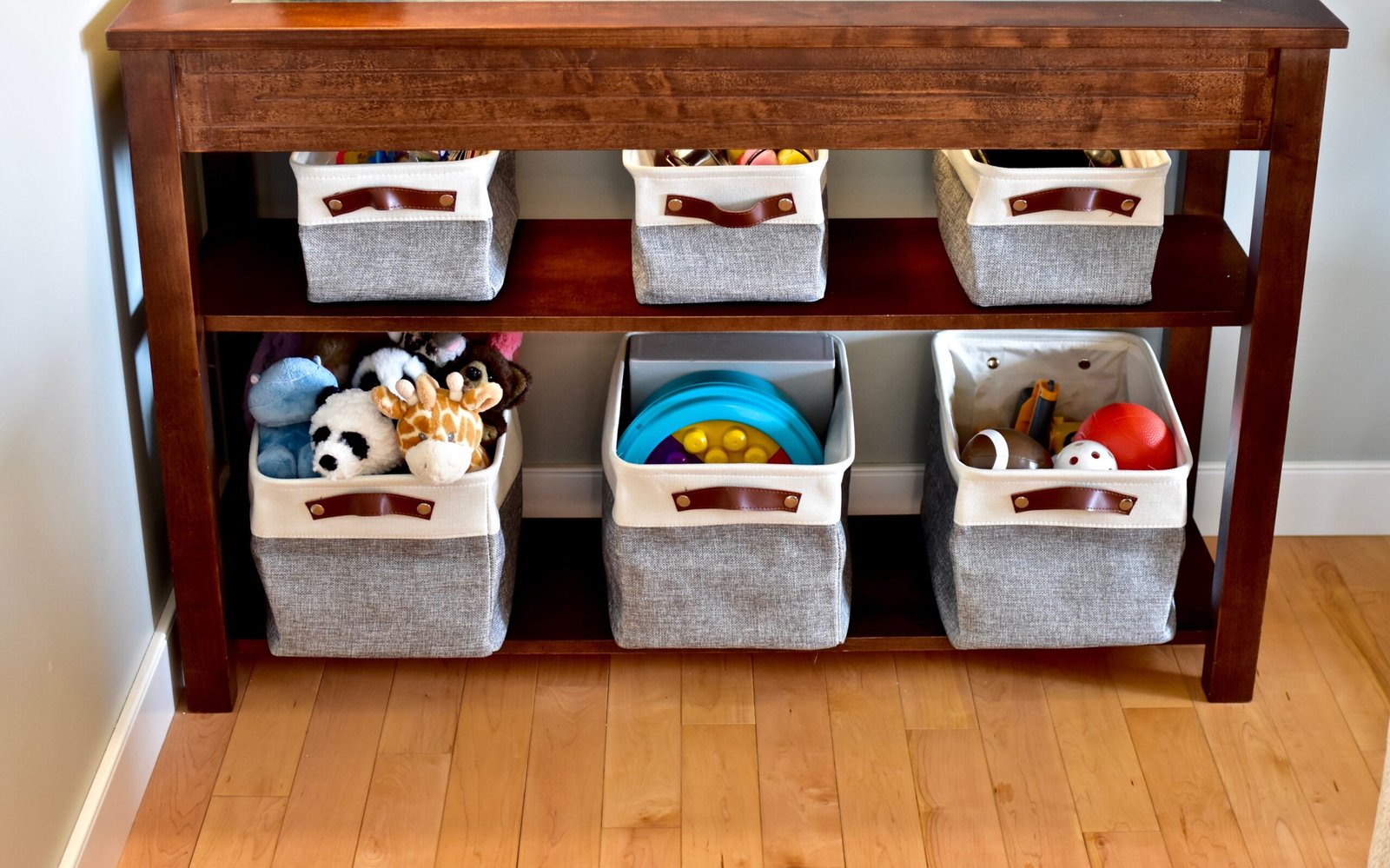
Let’s talk about toys in small living rooms.
Not the catalogue playrooms with custom-built cubby holes, colour-coordinated wooden blocks, and acres of floor space.
I mean the real setup. The compact UK living room (which averages just 4m x 3m) where the sofa is already dangerously close to the coffee table. The tricky corner where the TV unit only just fits. The one shared space that has to function as a lounge, a dining room, a home office, and—since the kids arrived—a soft play centre.
If you’re searching for toy storage for small living rooms, the answer isn’t more baskets — it’s smarter containment.
In small homes, toys don’t stay contained. They migrate. Plastic dinosaurs end up under the sofa. Stray bits of Lego embed themselves in the rug. A half-built wooden train track cuts the room in two. And at 9 PM, when you finally sit down with a cup of tea, you are staring at a pile of primary-coloured chaos.
The problem isn’t necessarily that your children have too many toys (although a good edit always helps). The problem is that small living rooms demand dual-purpose infrastructure. If toy storage doesn’t actively blend into the adult space, it takes over entirely.
Good toy storage in a shared space isn’t about hiding childhood. It’s about containing it. Here is how to make toys live in your lounge without the room feeling like a nursery.
If you’re in one of those flats with no cupboards at all, these storage ideas for flats with no storage show how to build proper infrastructure first.
1. The Closed Storage Rule (Battle Cognitive Fatigue)
Open toy storage looks cute in catalogues, but in a small living room, it causes cognitive fatigue. The Science: Children’s toys are designed using high-contrast, primary colours specifically to grab attention. When you have dozens of these bright, mismatched shapes sitting on an open shelf, your adult brain is constantly processing that sensory overload, making it physically harder to relax.
The Fix: Solid Doors. Hide the toys behind closed fronts wherever possible.
- Use cabinets with solid doors instead of open bookcases.
- If you have a cube shelving unit (like the ubiquitous IKEA Kallax), fill the bottom rows with opaque, solid-coloured inserts. When the toys are hidden behind a flat surface, the room immediately exhales and feels like an adult space again.
2. The Ottoman Swap (Geometry & Safety)
If you currently have a standard wooden or glass coffee table, consider swapping it for a large storage ottoman.
Why it works in small living rooms:
- The Volume: A standard 90cm x 45cm storage ottoman has the exact same footprint as a coffee table, but it holds over 100 litres of storage.
- The Safety Factor: Upholstered ottomans have soft edges. In a tight room where toddlers are running around, removing sharp wooden corners prevents daily tears.
- The Function: It serves as a footrest, extra seating for guests, and a massive cavern for train sets or dress-up clothes. Add a heavy wooden tray on top so you still have a stable surface for your evening drinks.
3. The 90cm Datum Line (Zone by Height)
In a shared living space, height dictates ownership.
The Anthropometrics: The average height of a 3-year-old is around 95cm. Their comfortable vertical reach is usually under 90cm. If you mix adult items and kids’ items on the same low shelves, the adult items will get broken, and the toys will slowly climb the walls until they dominate the room.
Establish a horizontal boundary:
- Lower Third (Under 90cm): Toy storage. Completely accessible to children. Easy for them to pull out, and more importantly, easy for them to put back.
- Upper Shelves (Above 90cm): Books, fragile décor, adult items.
Clear vertical zoning keeps the room balanced.
4. The 5-Minute Reset (Macro vs. Micro Sorting)
In small spaces, daily reset time must be minimal. If it takes 20 minutes to micro-sort toys into 15 different labelled boxes, you simply won’t do it when you are exhausted.
Design for speed using “Macro-Sorting.” Young children do not possess the fine motor skills or the patience to sort toys perfectly by category. Instead of fighting nature, use broad, forgiving categories:
- One large basket for “Soft Toys.”
- One heavy-duty plastic bin for “Building Blocks.”
- One box for “Vehicles.”
- One catch-all bin for “Random Bits.”
The goal is a rapid, 5-minute sweep before bedtime, where everything is scooped up and dropped into a broad category—not a museum archive.
5. Slimline Furniture (Protect the Walkways)
Small living rooms cannot handle bulky toy chests sticking out 50cm from the wall. They choke the flow of the room.
The 80cm Clearance Rule: You need a minimum of 80cm between pieces of furniture to walk comfortably without twisting your shoulders. If you place a deep toy box in a narrow alcove, it will jut out into the walking path, creating daily friction.
- Look for slim sideboards or cabinets that are 35–40cm deep max.
- Use the alcoves beside the chimney breast (which are typically 35cm deep in UK period homes) to build flush, low-level cabinets that don’t intrude into the room.
If you’re renting, these storage ideas for rented homes explain how to create closed storage without drilling into the walls.
6. The Psychology of Toy Rotation
When floor space is limited, Rotation beats Expansion. Child Psychology: Studies show that children actually play more deeply, and more creatively, when they have fewer toys available. Too much choice leads to “play paralysis,” where they just dump every box out and walk away.
The Habit:
- Keep 50% of their toys in the living room.
- Store the other 50% in an under-bed storage box or a loft.
- Every three to four weeks, swap them over. The “old” toys will suddenly feel brand new, and your living room doesn’t become a permanent warehouse for everything they have ever been gifted.
7. Sofa-Adjacent Baskets (The Proximity Principle)
Children naturally want to play exactly where you are. If you are on the sofa, they will drag their toys to the foot of the sofa.
Instead of fighting this proximity principle, design for it. Place one large, beautiful woven basket directly beside or behind the sofa.
- The Rule: It holds “active” toys only. When the basket is full, nothing new enters the living room until something goes back to their bedroom.
- The Material: Use natural materials like seagrass, rattan, or felt. This adds lovely adult texture to the room while secretly hiding bright plastic toys inside.
8. Wall-Mounted Book Ledges (Face-Out Reading)
Children’s books are notoriously difficult to store on standard adult bookshelves. They are unusually tall, very thin, and floppy.
The Solution: Acrylic or wooden picture ledges.
- They are only 10cm deep, meaning you can mount them behind doors or in tight hallways without blocking movement.
- Face-Out Display: Storing books with the cover facing outward encourages early reading and makes it much easier for a child to select a book without pulling 20 others onto the floor.
Mount into studs or use heavy-duty plasterboard anchors.
9. The 80% Capacity Buffer
If every single toy box is packed tight to the brim, the system will fail.
You must leave a 20% buffer in every storage container. Why? Because life happens. Grandparents visit with a new puzzle. A party bag arrives. They build a Lego creation they refuse to break apart. If your storage is at 100% capacity, that new item has nowhere to go except the floor. That empty 20% is your pressure relief valve.
Final Thoughts
Toy storage in a small living room isn’t about eliminating childhood joy. It’s about respecting the shared space.
When toys have defined, macro-sorted homes, when those homes are hidden behind solid doors, and when the volume is kept in check through rotation, your living space can seamlessly transform back into your space at 9 PM.
Start with one high-impact change: Swap the coffee table for a storage ottoman. That single swap often solves more problems than adding three extra baskets ever will.
2 thoughts on “Toy Storage Ideas for Small Living Rooms (Without Turning Your Home Into a Playroom)”
Comments are closed.