Let’s talk about flats with zero storage.
Not the shiny new-build brochures that boast about “ample fitted wardrobes” and “generous utility cupboards.”
I mean the real ones. The converted Victorian terrace with beautiful high ceilings, a stunning fireplace, and absolutely nowhere to put the hoover. The one-bedroom flat where the combi-boiler took up the only cupboard, leaving you without an airing cupboard for towels. The open-plan living space where the kitchen has four cabinets and a prayer, and your ironing board lives permanently wedged behind the sofa.
Flats without built-in cupboards aren’t just inconvenient—they are psychologically loud. When everything you own is visible, your brain never gets to switch off. Coats sit on dining chairs. Shoes line the skirting board. Cleaning products live under the sink right next to the kitchen bin. The vacuum cleaner becomes a depressing piece of modern art in the corner of the lounge.
The problem isn’t that you own too much stuff. The problem is that flats without built-in storage demand Intentional Infrastructure. If the architect didn’t build the cupboards, you have to build them yourself.
Here storage ideas for flats with no storage, without making your flat feel like a warehouse.
1. Fake the Built-In (The Alcove Strategy)
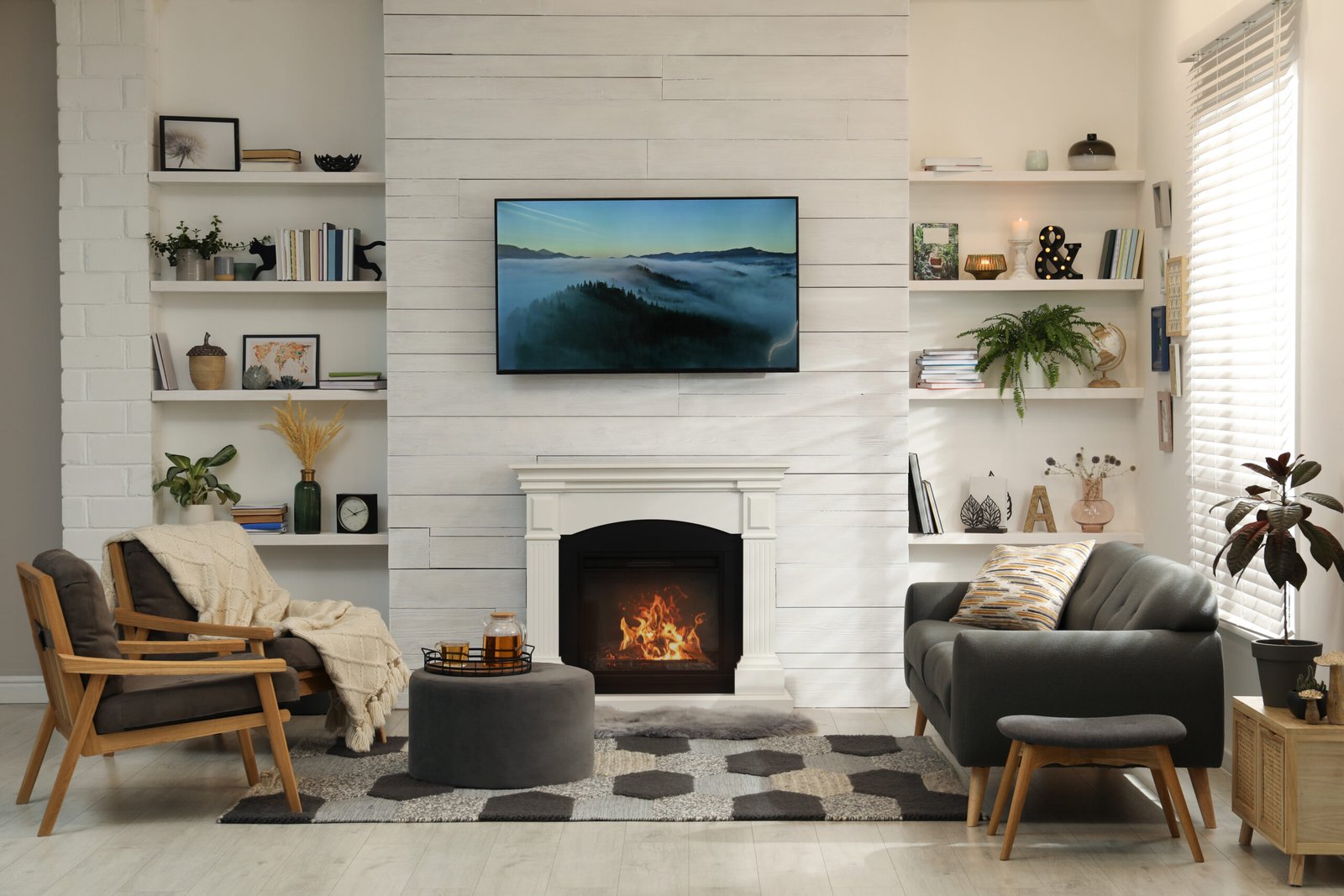
If you live in a UK period conversion, you likely have a chimney breast in the living room or bedroom. That leaves two alcoves on either side. These alcoves are typically 80–100cm wide and 35–40cm deep.
Do not just put a small, low bookcase in there. That wastes the vertical space.
- The Strategy: Buy freestanding, ceiling-height wardrobes or shelving units that fit snugly into those alcoves.
- The “Colour Drench” Hack: Paint the freestanding wardrobes the exact same colour as the walls. This is an interior design trick called colour drenching. It tricks the eye into reading the bulky furniture as part of the architecture, making it look like a custom built-in cupboard for a fraction of the cost.
If children share your lounge space, smart toy storage in a small living room becomes essential to keep the room feeling adult after bedtime.
2. The Hoover Problem (Build a “Utility Wardrobe”)
Where do you put the vacuum cleaner when you don’t have a utility cupboard?
The Dimensions of Chores:
- A standard cylinder vacuum (like a Henry) needs a footprint of about 40cm x 40cm.
- A folded ironing board is roughly 150cm tall.
- A stick vacuum needs a wall mount and a plug socket.
The Fix: You need to dedicate one tall, closed piece of furniture entirely to maintenance. Buy a single, slim wardrobe frame (e.g., a 50cm wide IKEA PAX or a tall metal locker) and place it in the hallway or the corner of the kitchen.
- Inside: Fit it with a high shelf for cleaning sprays, leave the bottom completely open for the vacuum, and add a side hook for the ironing board. Once the hoover has a “door” to hide behind, your flat instantly feels cleaner.
3. The Ottoman Bed (Physics of the Small Flat)
When you don’t have cupboards, bulk items become the enemy. Suitcases, winter coats, spare duvets, and Christmas decorations cannot sit out.
You need the space under your bed. But in a small flat, standard drawer-beds often fail. The Physics of Clearance: A pull-out under-bed drawer requires at least 60cm of empty floor space to open fully. If your bedroom is tight on space too, these small bedroom storage ideas show how to layer vertical and under-bed systems properly.
The Solution: The Gas-Lift Ottoman Bed. Ottoman beds lift upward on gas struts. They require zero extra floor space to open. It essentially gives you a horizontal wardrobe the exact size of a double mattress. Store your bulky items inside vacuum-sealed bags to double the capacity and protect them from dust.
4. The “Airing Cupboard” Replacement
Older UK homes had an airing cupboard housing the hot water cylinder. It was where the towels and spare sheets lived. Modern combi-boilers removed the cylinder, and suddenly, flats lost their linen storage.
Bedding and towels take up massive cubic volume. The Fixes:
- The “Pillowcase Parcel”: Fold your duvet cover, fitted sheet, and one pillowcase neatly, and slide them all inside the second pillowcase. This creates a tight, stackable fabric “brick” that won’t unfold. You can stack these neatly on the very top shelf of your clothes wardrobe.
- Spa-Rolling Towels: Folded towels take up wide, flat space. Tightly rolled towels can be stacked vertically in a deep drawer or a decorative basket in the bathroom.
5. Go Tall Before You Go Wide (The “Air Rights”)
Flats are often short on floor space but generous in ceiling height. Most people buy bookcases that are 1.8m tall, leaving a metre of empty air above them.
Maximise the Vertical:
- Buy units that go as close to the ceiling as possible (2.3m+).
- The Rule of Visual Weight: Keep the bottom half of these tall units closed (with solid doors) to hide the ugly, chaotic stuff (paperwork, cables, gym gear). Keep the top half open for books and plants. This stops the tall furniture from feeling too heavy and dominating the room.
In kitchens especially, vertical thinking is essential—these kitchen storage ideas for renters show how to apply it without fixing anything to walls.
6. Manufacturing a “Micro-Hallway”
Many modern flats have front doors that open directly into the open-plan living room/kitchen. There is no hallway. There is no cloakroom.
If you don’t build a “Micro-Entryway,” your coats will migrate to the dining chairs, and your shoes will permanently block the walkway.
The Minimum Viable Setup: You need a zone that is strictly for arrivals and departures.
- The Shoe Cabinet: Use an ultra-slim, tip-out shoe cabinet (under 20cm deep). Place it right next to the door. It acts as a physical boundary.
- The Wall Hooks: Install 3 or 4 sturdy hooks above the shoe cabinet.
- The Tray: Place a small dish on top of the shoe cabinet for keys.
This creates a psychological “drop zone.” The mess stops here and does not infect the living room.
7. Modular Cubes (The “Tetris” Approach)
When there are no built-in cupboards, consistency in your freestanding furniture matters. If you have a random oak side table, a white painted chest of drawers, and a metal wire rack all in one room, the visual noise is deafening.
Modular systems (like cube shelving) create rhythm.
- Why they work: They act like architectural building blocks. You can stack them horizontally under a window, or vertically in a tight corner.
- Containment: Buy solid-coloured fabric or woven inserts for the cubes. Four different items sitting on a shelf = four visual signals for your brain to process. Four items hidden inside one matching basket = one visual signal. It creates immediate visual compression and calm.
If you’re renting, these storage ideas for rented homes expand on fully reversible, deposit-safe systems.
8. The 80% Capacity Rule
In a flat with no built-in storage, you cannot live at 100% capacity. There is no hidden overflow zone.
If every single shelf, basket, and hook is packed tight:
- Putting things away becomes a physical chore.
- You start leaving things on the kitchen counter instead of fighting the full shelf.
- The floor becomes the new storage zone.
You must leave a 20% buffer. Leave one cube empty. Leave a gap on the bookshelf. Keep one coat hook completely free. That empty space is what absorbs the randomness of life—a wet umbrella, a parcel delivery, a bulky winter coat—without tipping the flat into chaos.
As flats also usually lack attic or garage storage, these storage ideas for homes with no loft or garage show how to create hidden capacity inside your living space.”
Final Thoughts
Flats with no built-in cupboards aren’t broken. They just require you to be the architect of your own storage.
You build upward. You hide the bulky items horizontally under the bed. You give the vacuum cleaner a dedicated vertical home. And you drastically reduce visual noise by choosing solid doors over open shelves.
When you stop waiting for cupboards to magically appear and start building intentional systems, the flat stops feeling like a temporary compromise—and starts feeling like a beautifully designed home.
4 thoughts on “Storage Ideas for Flats With No Built-In Cupboards (When There’s Nowhere to Hide Anything)”
Comments are closed.