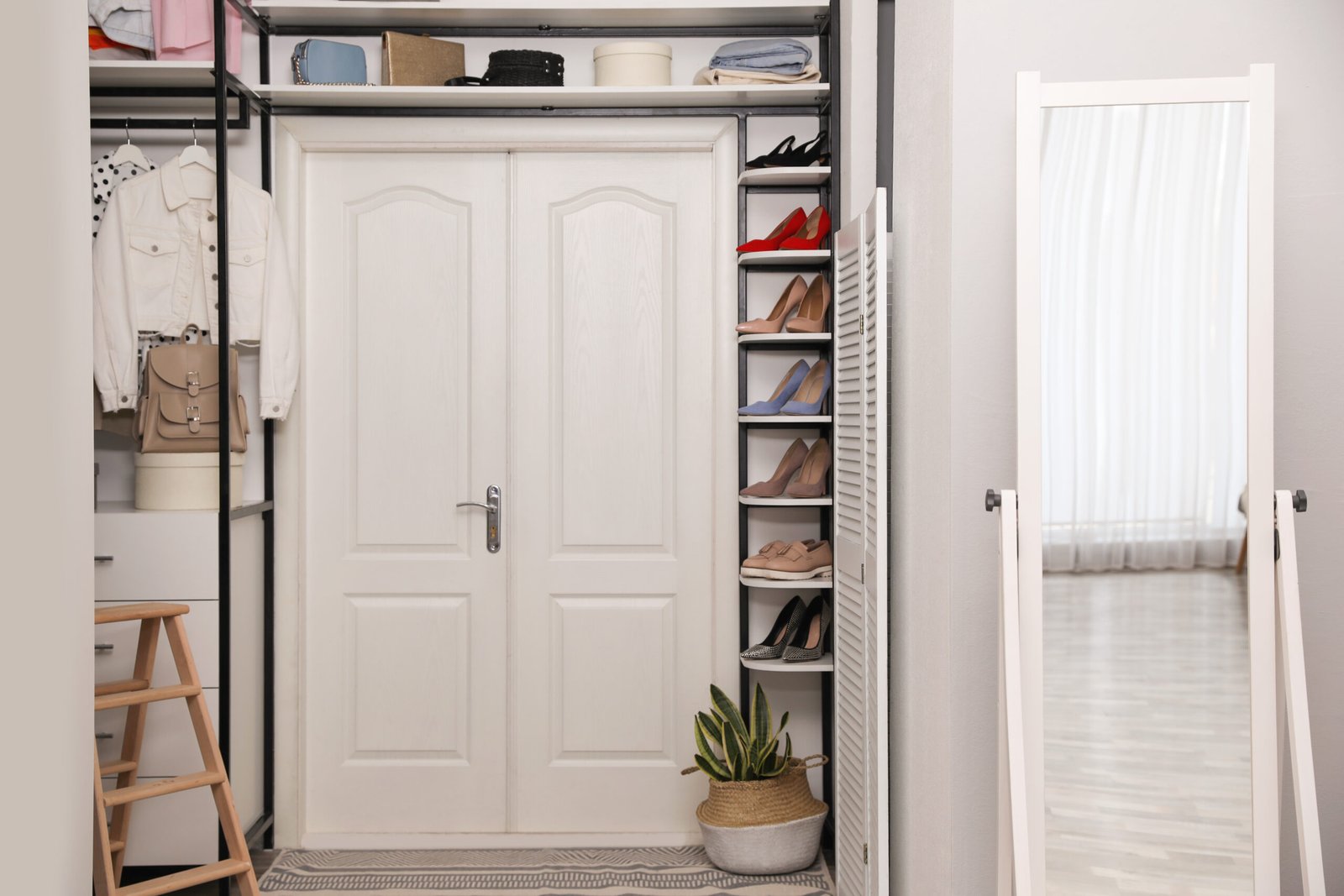
Let’s talk about rented homes.
Not the “Dream Rentals” you see on Pinterest, with exposed brick, custom shelving, and a landlord who says, “Of course you can knock that wall down, darling.”
I mean real rented homes. The magnolia walls you aren’t allowed to paint. The flimsy plastic curtain rails you didn’t choose. The kitchen cupboard doors that don’t quite line up. The tenancy agreement clause that makes you nervous about even changing a lightshade.
Renting comes with a particular kind of frustration. You want your space to feel calm, organised, and functional—but you can’t drill holes everywhere, rip out awkward cupboards, or install custom fitted wardrobes. So, things drift.
- Shoes pile up because you can’t wall-mount a cabinet.
- Coats hang off door handles because there’s nowhere permanent to put hooks.
- Cables snake across the floor because you can’t chase them into the plaster.
Here’s the truth: Good storage in a rented home isn’t about permanent upgrades. It’s about Temporary Infrastructure.
You build systems that stand, lean, slot, hang, and lift—without leaving a trace. Here is how to make a rented home work properly, without risking a single penny of your deposit.
Many renters also face the added challenge of having no attic or garage space at all, which is where these storage ideas for homes with no loft or garage become essential.
1. The Golden Rule: Frictionless & Reversible
Every storage solution in a rented home must pass two tests:
- Can I remove this in under 10 minutes?
- Will it leave zero marks behind?
If the answer is no, it is not rental-safe. That doesn’t mean you are limited to flimsy cardboard boxes. It just means you prioritise specific mechanics: Tension, Adhesion, and Gravity. Think “Architectural Lego,” not “Renovation.”
If you have children, toy storage in a small living room needs to be fully reversible and renter-friendly too.
2. The Science of Command Hooks (Use Strategically)
Adhesive hooks (like Command) have a bad reputation because people overload them, rip them off, and take a chunk of plaster with them. Used correctly, they are the renter’s best friend.
The Physics of Adhesion:
- Preparation: You must clean the wall with rubbing alcohol (surgical spirit) first. Wall paint has grease and dust on it. If you stick a hook to dust, it falls off.
- Wait Time: Apply the strip. Wait 24 hours before hanging anything. The adhesive needs time to cure.
- Removal: Pull the tab slowly straight down against the wall. Never pull it out towards you. That is what rips the paint.
Where to use them:
- Inside cupboard doors (for tea towels/measuring spoons).
- By the front door (for keys/light jackets).
- Avoid: Vinyl wallpaper (the plasticiser makes the glue fail) and radiators (heat melts the glue).
3. Tension Rods (The Physics of Friction)
Tension rods require zero screws. They work by pushing outward against two solid surfaces. They create instant structure.
Unexpected Uses:
- The “Under-Sink” Rail: Put a tension rod inside the sink cupboard. Hang your spray bottles by their triggers. It doubles your storage instantly.
- Vertical Dividers: Install tension rods vertically between shelves to create dividers for baking trays or chopping boards.
- The “Nook” Curtain: If you have an ugly open shelf or a messy alcove, put a tension rod across the top and hang a piece of nice fabric. Visual clutter: gone.
4. Over-Door Storage (Know Your Door Depth)
Doors are free real estate in rentals. Over-door organisers can hold shoes, towels, dressing gowns, and bags. But there is a trap.
The 35mm vs. 44mm Problem:
- Standard UK internal doors are usually 35mm thick.
- Fire Doors (common in flats/apartments) are 44mm thick. Most cheap over-door hooks are made for 35mm doors. If you force them onto a fire door, they will scrape the paint off the frame every time you close it. The Fix: Measure your door. Buy hooks that fit exactly, or look for “adjustable” width hooks. Always add a small felt pad (like the ones for chair legs) to the underside of the hook to protect the woodwork.
5. Freestanding Vertical Units (The Anti-Tip Risk)
If you can’t drill shelves into walls, your best friend is Height. You need furniture that goes up, not out.
- Ladder Shelves: These lean against the wall. Gravity keeps them stable. They look built-in but require zero fixings.
- Bathroom Towers: Slim, tall units (often 30cm wide) that fit in tight corners.
Safety Warning: Tall, narrow furniture (like IKEA Billy bookcases) is unstable on carpet. Homeowners drill them to the wall. Renters often can’t.
- The Renter Fix: Load the bottom shelf with your heaviest items (hardback books, vinyl records). This lowers the centre of gravity. If you have kids or pets, do not use tall, unsecured furniture. It is a crushing hazard.
6. Furniture That Doubles as Storage
In rented homes, you don’t usually get fitted cupboards. Your furniture must carry the load. Every piece of furniture must have a job.
- The Ottoman Bed: This is the single biggest storage upgrade you can make. The entire space under the mattress becomes a wardrobe. Perfect for suitcases and winter coats.
- Storage Footstools: Instead of a coffee table (which is just a surface), use a storage footstool with a tray on top. Inside: blankets, board games, router cables.
- The “Click-Clack” Sofa: Many sofa beds have storage underneath the seat.
Rule: Never buy a bed or a sofa on legs if you are short on space. Buy one with a base that opens.
If you’re working with a tight layout, many of these small bedroom storage ideas build on the same principle of using the bed footprint properly.
7. Cable Management (Visual Calm)
Loose cables snake across the floor and make a rental feel temporary and messy. You can’t chase them into the wall, but you can hide them.
The “Non-Destructive” Kit:
- Cable Clips (Nail-in): Check your lease. Often, tiny pin-holes are considered “fair wear and tear” while drill holes are not. You might be allowed to tack cables to the skirting board.
- Adhesive Trunking: D-Line trunking sticks to the wall to hide TV cables. Warning: The adhesive is very strong. Use a hairdryer to warm it up before removing it when you move out, or it will pull the plaster off.
- Velcro Ties: Bundle cables behind the TV. Never use zip ties—you can’t reuse them.
8. Renter-Friendly Kitchens (The Rolling Cart)
Rental kitchens often have terrible layouts. A fridge in the wrong place. One drawer that sticks. No pantry.
The Fix: The Rolling Cart (e.g., IKEA Råskog).
- Why it works: It is a mobile island.
- Uses:
- Coffee Station: Kettle, mugs, jars.
- Vegetable Rack: Potatoes and onions.
- Pantry Overflow: Tins and pasta.
- The Exit Strategy: When you move, you just wheel it into the moving van. It requires no disassembly.
The kitchen often presents the biggest challenge for renter— for a more in depth look our piece on kitchen storage ideas for renters show how to organise it without drilling.
And If your existing cabinets are deep and awkward, these kitchen cupboard storage ideas will help you bring everything to the front without installing permanent hardware.
9. The “Exit Strategy” Rule (Modular Thinking)
Before buying any storage item, ask:
- Will this work in my next place?
- Can I transport it easily?
Avoid hyper-specific fitted systems that only work in one exact alcove dimension.
- Good: Modular cubes (Kallax style), freestanding rails, stackable bins.
- Bad: Custom-width shelving, huge corner sofas that might not fit through the next hallway.
Rented living rewards Modular Thinking.
For period conversions or newer flats with no cupboards at all, these storage ideas for flats with no storage show how to build structure from scratch.
10. The Psychological Shift (Stop Waiting)
Many renters unconsciously treat their home as temporary—even if they’ve lived there for five years. They live out of boxes. They don’t buy the nice storage bin because “what’s the point?”
The Truth: You deserve a calm space now. Friction compounds daily. Tripping over shoes for three years is stressful, regardless of who owns the deed.
Final Thoughts
Storage ideas for rented homes aren’t about “hacking” your landlord’s property. They’re about building Temporary Infrastructure that gives you ownership over how the space functions.
Freestanding. Tension-based. Stackable. Reversible. Start small: Add one tension rod under the sink. Stick two hooks by the door. Upgrade your bed base. You don’t need permission to make your home functional. You just need systems that leave no trace when you leave.
If you have a spare box room in a rental property, these box room storage ideas show how to build more efficient storage without major alterations.
5 thoughts on “Storage Ideas for Rented Homes (No Drilling, No Deposits Lost)”
Comments are closed.