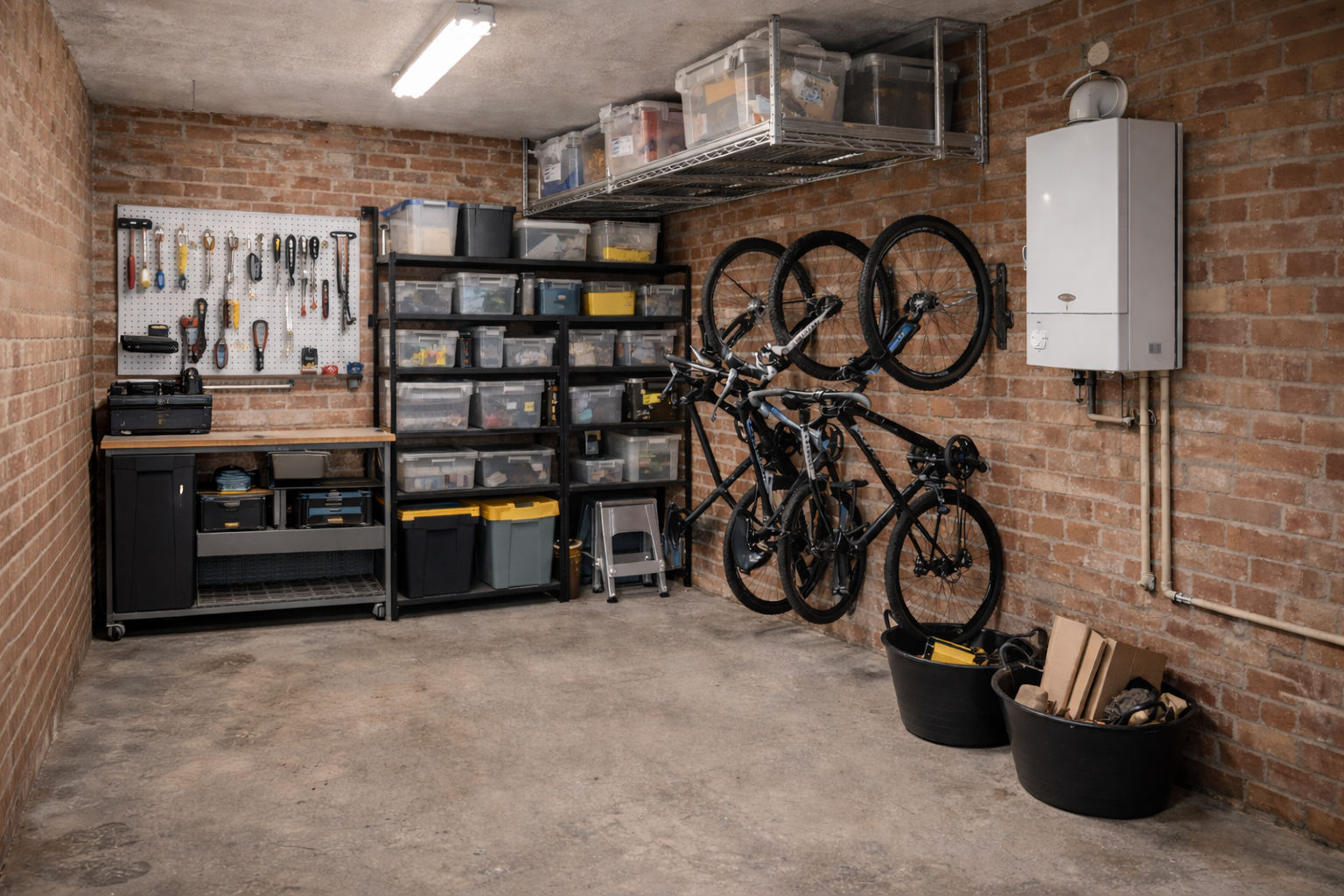
Let’s talk about small UK garages.
Not the double garages you see in American home renovation shows, with epoxy floors, space for two SUVs, a massive workbench, and room to roller-skate.
I mean real UK garages. The 2.4m-wide concrete box built in the 1970s. The one with the up-and-over door that rattles in the wind. The one that was technically designed for a Morris Minor but now holds a modern hatchback, three bikes, half a tin of Dulux from 2018, and a broken freezer.
Small garages don’t fail because they are small. They fail because they slowly become horizontal dumping grounds.
- The floor fills first.
- Then the walls get leaned on.
- Then the “path of desire” to the freezer gets blocked.
- Eventually, you can’t park the car, you can’t find the drill, and opening the door fills you with a sense of defeat.
Good small garage storage ideas aren’t about cramming more shelving in. They’re about reclaiming vertical space, zoning by function, and battling the specific damp conditions of British brickwork.
For a broader breakdown of zoning and wall systems, see our full guide to garage storage ideas.
Here’s how to make a small UK garage work properly—even if it’s barely wider than your car.
1. The Geometry of the “Door Ding” (Do The Maths)
Before you buy shelving, you must accept the brutal maths of UK housing. A standard single garage is roughly 2.4m wide. A modern family car (e.g., a VW Golf or Ford Focus) is roughly 1.8m wide (including mirrors). That leaves you 30cm of clearance on either side.
The Hard Truth: You need at least 60cm to open a car door comfortably and get out. If you put standard 40cm-deep shelving on the side walls, you physically cannot open your car door. You have turned your garage into a shed.
The Fix:
- Side Walls: Strictly for items flatter than 15cm. (Ladders, folding chairs, garden tools on hooks).
- The “Power Wall”: The back wall (opposite the door) is your only deep storage zone. This is where the 45–60cm deep shelving units go.
This is similar to the clearance rules we apply in narrow corridors — if you’ve ever struggled with tight entrances, our small hallway storage ideas guide breaks that down.
2. Battle the “Single Skin” Damp
Most detached UK garages are built with “Single Skin” brickwork (one layer of brick). This means they get cold. They get condensation. And they get damp. If you store cardboard boxes on a concrete garage floor, they will act like a sponge, wicking up moisture. Within a month, the bottom falls out. Within a year, you have mould.
The Moisture Rules:
- Ban Cardboard: Use plastic heavy-duty totes (with lids).
- The “Air Gap”: Do not push storage units flush against a single-skin external wall. Leave a 2cm gap for airflow. This stops mould growing behind the shelf.
- Metal Care: Tools rust in damp garages. Keep expensive tools in a sealed toolbox with a silica gel packet or a VCI (Vapour Corrosion Inhibitor) capsule.
3. Verticality: Rafters vs. Trusses (Structural Safety)
UK garages usually have plenty of headroom. This is prime real estate. But be careful. You need to know if you have Rafters (traditional angled beams) or Trusses (modern W-shaped webs of thin timber).
- Traditional Rafters: Stronger. You can board these out to create a mini-loft for lighter items.
- Modern W-Trusses: These are engineered for roof load only. They are surprisingly fragile if you hang heavy weights from the bottom chord.
- Safe: Empty suitcases, plastic Christmas tree, lightweight garden cushions.
- Unsafe: Heavy boxes of books, car engines, gym weights.
The System: Use “overhead storage racks” that bolt into multiple joists to spread the load.
4. Bikes: The “Top and Tail” Strategy
Bikes are awkward. Handlebars are wide (70cm+). If you lean three bikes against a wall, they take up half the garage.
The Fixes:
- The Vertical Hook: Hang the bike by the front wheel, perpendicular to the wall. This takes up only the width of the handlebars.
- Top and Tail: If you hang multiple bikes, alternate them (one up, one down). This stops the handlebars clashing and allows you to pack them tighter (every 30cm instead of every 60cm).
- The Ceiling Hoist: A pulley system lifts the bike into the roof space. Great for the “Sunday best” bike, annoying for the daily commuter bike.
5. Twin-Slot Shelving (The Adjustable Hero)
Freestanding racking is great, but it has legs that get in the way of sweeping. For UK brick walls, Twin-Slot Shelving (upright metal tracks screwed into the wall with movable brackets) is superior.
- Why it wins:
- Zero Footprint: No legs on the floor. Easy to sweep out leaves/dust.
- Infinite Adjustment: You can move shelves up or down to fit a specific item perfectly.
- Depth Choice: You can put deep shelves high up (above head height) and shallow shelves lower down (to save car door space).
6. Pegboards are Frictionless
Toolboxes stacked inside cupboards create Friction. To get a screwdriver, you have to: Open cupboard > Unstack toolbox > Open latches > Dig. You won’t do it. You’ll leave the screwdriver on the side.
The “Shadow Board”: Mount a pegboard or a sheet of ply on the wall.
- Hang screwdrivers, pliers, hammers, and tape measures.
- The Benefit: Instant visual inventory. You know exactly where the 10mm spanner is.
- UK Sizing: Look for metric pegboards (usually 25mm hole spacing) so standard hooks fit.
7. Hazardous Zoning (The Boiler Factor)
Many UK garages house the combi boiler or the gas meter. Safety Check:
- Heat Zone: Do not store paint or chemicals next to the boiler. The temperature fluctuation can degrade the paint or cause pressure in aerosol cans.
- Flammables: Never store petrol (for the mower) or thinners near a pilot light or boiler spark.
- Frost: Latex paint ruins if it freezes. If your garage is unheated, store paint in the house (utility room or cupboard), not the garage.
8. The “Outbox” (The Tip Run)
Garages collapse because they become the “Pre-Bin.” Broken chairs. Old electronics. Cardboard for recycling.
Designate a “Tip Zone.”
- Use two heavy-duty builder’s trugs or flexi-tubs near the garage door.
- Tub 1: Recycling.
- Tub 2: The Tip (Household Waste site).
- Rule: When the tub is full, you go to the tip. Do not let it overflow onto the floor.
9. Lighting: The LED Upgrade
Most UK garages have one sad, yellow 60W bulb hanging in the middle. It creates shadows. It makes the space feel dingy and abandoned.
The Fix: LED Battens.
- Replace the single bulb with two 4ft or 5ft LED batten lights.
- Colour Temperature: Go for “Cool White” (4000K–6000K). It looks like daylight.
- When a garage is bright, you treat it like a room. When it is dark, you treat it like a cave.
10. The 80% Capacity Rule
If your garage is filled to 100% capacity (floor to ceiling), it is not storage—it is a blockage. You need “Breathing Space.”
- A clear patch of floor: To inflate a tyre or assemble a flatpack.
- One empty shelf: For the temporary project.
- The Buffer: That space prevents the “slow creep” of clutter blocking the door.
Final Thoughts
Small UK garages don’t need clever hacks. They need Hierarchy.
- The Car: Takes priority.
- The Back Wall: Takes the heavy storage.
- The Side Walls: Stay shallow (under 15cm).
- The Ceiling: Takes the light, bulky items.
Start with one change: Get everything off the floor. Once you can see the concrete perimeter again, the panic subsides, and you can start building a system that actually works.
2 thoughts on “10 Garage Storage Ideas for Small UK Garages That Don’t Just Turn Into Expensive Sheds”
Comments are closed.