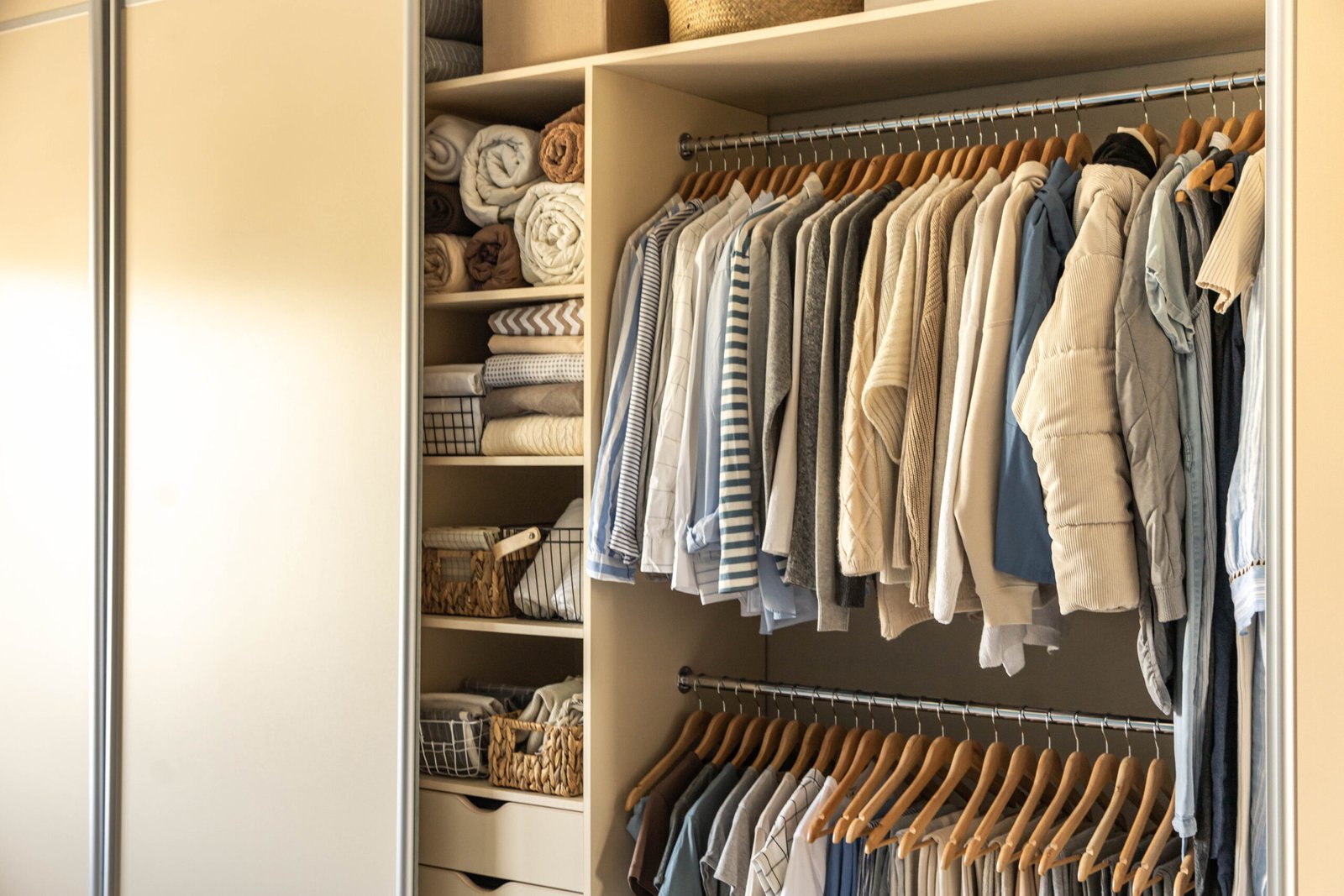
Let’s be honest: wardrobes have two moods.
Mood One: Beautiful, colour-coordinated, Pinterest-worthy perfection. The kind where every shirt is spaced exactly one inch apart, and you can hear angels singing when you open the door.
Mood Two: A chaotic “fabric avalanche” where everything you own is technically somewhere inside, but the second you need it, it vanishes into the void.
Most of us live firmly in Mood Two.
You know the drill. You open the wardrobe door on a Tuesday morning, already five minutes late. You reach for a shirt, but it’s crushed between two winter coats. A hoodie falls off a hanger and lands on your head. You can find one sock, but its partner has apparently run away to start a new life.
You stare at a wardrobe bursting with clothes and think the universal thought: “I have absolutely nothing to wear.”
Here is the truth: A messy wardrobe has nothing to do with being a messy person. It’s because most standard wardrobes aren’t designed for how human beings actually live. They are big, empty boxes that we stuff full of hopes, dreams, and impulsive sale purchases.
The good news? You don’t need a walk-in closet the size of a boutique, and you don’t need expensive custom joinery. You just need a smarter system.
Here are the best wardrobe organisation ideas that actually work for real people—strategies that will turn your “panic dressing” mornings into peaceful ones.
1. The Brutal (But Necessary) Edit
Let’s rip the band-aid off first. You cannot organise clutter.
If your wardrobe is overflowing, no amount of fancy hangers or drawer dividers will save you. You have to edit.
But this isn’t just about throwing things away; it’s about confronting your “Fantasy Self.” We all have clothes for the person we think we should be. The “hiker” who never goes hiking. The “glamorous party-goer” who actually prefers staying in with a book. The “size we used to be” or the “size we hope to be.”
The Sorting Process: Pull everything out. Yes, everything. Pile it on the bed. Then, sort into four piles:
Love It: You wear it, it fits, you feel good in it. Keep.
The “Maybe” Pile: You haven’t worn it in a year, but you’re scared to let go. (Put these in a labelled box. If you don’t reach for anything in six months, donate the lot.)
The “Fantasy” Pile: Costumes, hobbies you quit, or clothes that pinch and make you miserable. Donate.
The Trash: Stained, ripped beyond repair, or bobbled to death. Recycle.
Be honest. If you haven’t worn it since 2019, the odds are not in its favour.
If space in the bedroom is already in short supply – take it even further and look a ways of organising a small bedroom.
2. The “Slim Hanger” Upgrade
This is the single fastest, most impactful upgrade you can make to a wardrobe. It takes zero skill and provides instant gratification.
Look at your current hangers. You probably have a mix: some wire ones from the dry cleaners, some chunky wooden ones, some white plastic ones that snap if you look at them wrong.
The Problem: Mismatched hangers create “visual noise.” They sit at different heights and take up different amounts of space.
The Solution: Velvet Slimline Hangers.
The Result: Because they are ultra-thin, you can fit 20% to 40% more clothes on the same rail, which is exactly what you want from wardrobe organisation ideas that genuinely work. Plus, the velvet grip stops your silky blouses from sliding off and ending up in a pile on the floor.
Suddenly, your wardrobe looks uniform and boutique-like.
3. Categorise Like a Shop Assistant
Your wardrobe should function like a shop where you are the only customer. You wouldn’t shop in a store where the jeans were mixed in with the pyjamas, so don’t do it at home.
The Hierarchy of Order:
Category: Group all shirts together, all trousers together, all dresses together (this alone feels life-changing).
Sleeve Length: Within “shirts,” go from tank tops → short sleeve → long sleeve.
Colour (Optional but satisfying): Go light to dark (white → grey → black).
Why this works: It reduces “Decision Fatigue.” When you wake up and think, “I need a long-sleeve top,” your hand automatically goes to that specific section. You aren’t hunting. You are retrieving.
4. The “Prime Real Estate” Rule
Not all space in your wardrobe is created equal.
The Hot Zone: The rail at eye level and the drawers at waist height.
The Cold Zone: The very top shelf and the very bottom floor.
The Mistake: Most people have their “Hot Zone” clogged up with things they rarely wear—like formal dresses, heavy winter coats in summer, or sentimental t-shirts.
The Fix: Only your weekly rotation lives in the Hot Zone — the things you actually wear Monday through Sunday.
Move the cocktail dresses to the far left or right edge.
Move the heavy coats to a different cupboard (or under the bed).
Move the sentimental items to a storage box on the top shelf.
If you open the doors and the first thing you see is stuff you actually wear, getting dressed becomes 10x faster.
5. File-Fold Your Drawers (The Kondo Method)
If you fold your t-shirts and jeans in a vertical stack (one on top of the other), you have a problem.
You can’t see the shirt at the bottom.
When you pull the bottom shirt out, the whole stack topples over.
The Solution: File Folding. Fold your clothes into small rectangles and stand them upright, like files in a filing cabinet.
This works for t-shirts, gym leggings, jumpers, and even jeans.
Visibility: You can see every single t-shirt at a glance.
Access: You can pull one out without disturbing the others.
Space: It compresses the air out of the clothes, allowing you to fit more in the drawer.
Once you switch to file folding, you will never go back to stacking.
6. Drawer Dividers: The Unsung Heroes
A drawer without dividers is just a bucket.
You throw your socks in there, and within three days, it becomes a “sock soup.” You can never find a matching pair, and your underwear gets tangled with your gym leggings.
Contain the Chaos:
Expandable Dividers: These are spring-loaded bamboo or plastic strips that fit any drawer size. They create distinct lanes.
Fabric Boxes: Ikea Skubb boxes are famous for a reason. They compartmentalize your drawer.
Box 1: Socks.
Box 2: Underwear.
Box 3: Bras/Shapewear.
When items have a specific “home address” within the drawer, they tend to stay there.
7. Maximise the “High Shelf” (Siberia)
Most wardrobes have that one high shelf at the top — also known as Siberia. It is usually too high to reach and becomes a graveyard for empty shoeboxes and bags you forgot you owned.
This is “Long Term Storage.”
Don’t stack loose piles here: They will topple over on your head when you try to reach them.
Use Handled Bins: Get large fabric or plastic bins with sturdy handles.
What goes here? Beachwear in winter. Chunky knits in summer. Spare handbags.
Label it: Because the bin is high up, you can’t see inside it. Put a label on the front so you don’t have to pull it down just to check what’s in there.
8. The Shoe Strategy (The Floor Is Lava)
Shoes are wardrobe disruptors. They are dirty, they are bulky, and they have an annoying habit of ending up in a giant pile at the bottom of the wardrobe.
If your shoes are in a pile, you will always wear the same pair (the ones on top).
Options for control:
Shoe Stackers: These little plastic gadgets let you stack one shoe on top of the other without dirtying them. It instantly doubles your floor space.
The Low Rail: If you have space, a small expandable shoe rack at the bottom of the wardrobe keeps them tidy.
Clear Boxes: If you have fancy shoes (heels, leather dress shoes), keep them in clear boxes to protect them from dust. Stack the boxes against the back wall.
9. Accessories: Don’t Let Them Drift Into Chaos
Jewellery, belts, scarves, and hats. These are the “small stuff” that makes a room look messy.
If you don’t have a specific spot for them, they end up draped over chairs or tangled on the dresser.
The Door: Use the inside of your wardrobe door! Add Command hooks for necklaces or scarves.
The Belt Hanger: Stop weaving belts through the hangers of your trousers (it makes them hard to get off). Get a dedicated belt hanger that holds 10 belts in one spot.
The “Catch-All” Tray: Have a small tray on your dresser for the jewellery you wear every single day (wedding ring, favourite watch).
10. The Seasonal Rotation (Shop Your Closet)
If you live in a climate with seasons, you should not have all your clothes out at once.
Why do you need to look at your wool jumpers when it is 30 degrees outside? It just creates visual clutter and makes it harder to find your t-shirts.
The Ritual: Twice a year (Spring and Autumn), do a swap.
Take the off-season clothes out. Wash them. Vacuum seal them or put them in under-bed storage bins.
Bring the new season clothes into the “Hot Zone.”
This serves two purposes:
It frees up massive amounts of space.
It feels like you went shopping. You rediscover clothes you forgot you had because you haven’t seen them for six months.
Final Thoughts
Wardrobe organisation is not about perfection. It is not about having a colour-coded, spotless space that looks like a magazine.
It is about function.
It is about opening the door at 7:00 AM, half-asleep, and being able to find a shirt, a pair of jeans, and matching socks in under 30 seconds without knocking anything over.
Start small. Buy a pack of velvet hangers this weekend. Or tackle just the sock drawer. Once you feel the calm of a sorted space, you won’t want to stop.
If you want another quick win, try organising your under-sink space — it’s surprisingly life-changing.
3 thoughts on “Wardrobe Organisation Ideas That Actually Make Your Clothes Easy to Find (No More Panic Dressing)”