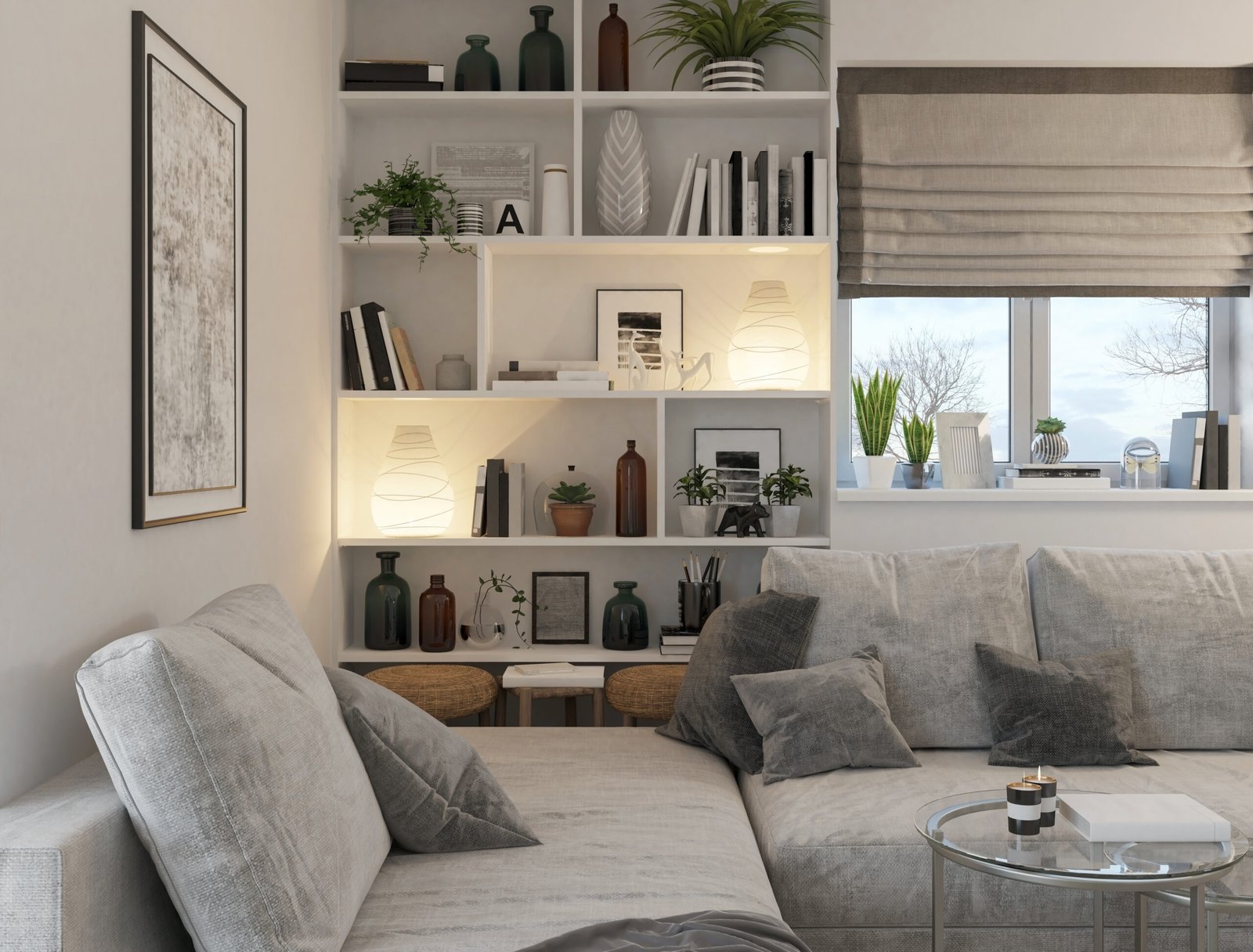
Let’s talk about vertical storage.
Not the Pinterest-style wall displays with perfectly colour-coded baskets, trailing ivy, and decorative wooden ladders holding a single, strategically folded throw.
I mean the simple, structural truth that most small rooms suffer from: people fill the floor first, and ignore the walls completely.
Walk into almost any cramped UK bedroom, hallway, or living room, and the pattern is identical. The sofa sits against the wall. A bookcase stops halfway up. The freestanding wardrobe reaches shoulder height. And above it all? Empty air.
If you’re dealing with the famously tiny third bedroom in a British home, these box room storage ideas show how vertical thinking completely transforms the space.
In most UK homes, ceilings are between 2.3 and 2.4 metres high. If all your furniture stops at 1.8 metres, nearly a third of the vertical volume in your room is totally unused. Small rooms do not fail because they lack floor area. They fail because they lack vertical thinking.
Vertical storage ideas for small rooms turn walls into usable infrastructure. Instead of fighting for square inches across the rug, you build upward. Here is how to use vertical space properly in small rooms, without making them feel like a warehouse.
1. The Ergonomic Layers (Floor First, Ceiling Last)
The biggest mistake people make with vertical storage is filling shelves randomly. You must treat your wall like an ergonomic map.
Think of a room as a three-layer system based on human biomechanics:
- The Lower Layer (0–90cm): This is the heavy lifting and drop zone. It should contain items you use daily that are heavy or require looking down into: drawers, shoe cabinets, toy boxes.
- The Middle Layer (90–180cm): This is your Primary Reach Zone. Between your waist and your eye line. Things you touch every single day go here: daily clothing, books you are currently reading, toiletries.
- The Upper Layer (180cm+): This is the Archive Zone. You need a step-stool to reach it comfortably. Items used occasionally live here: spare bedding, tax paperwork, seasonal décor, memory boxes.
When you assign each height a specific job, the room feels logically structured instead of chaotic.
2. The 50cm Gap (Buy Furniture That Touches the Ceiling)
Why do so many people buy wardrobes and bookcases that stop at 1.8m tall? Usually because flatpack furniture is heavy, and building it is easier when it is short.
But in a small room, leaving a 50cm gap between the top of the wardrobe and the ceiling is a huge waste of volume.
- The Dust Trap: That empty space often turns into a clutter zone where random suitcases and broken fans gather dust.
- The Fix: Choose fitted wardrobes or modular shelving units that reach as close to the ceiling as possible. Ceiling-height storage can add hundreds of litres of capacity without increasing the footprint of the furniture on the floor.
- The Visual Trick: If you have a 10cm gap at the top, add a matching plinth or fascia board to close it off. Furniture that goes flush to the ceiling draws the eye upward, making the room look taller.
3. The Perimeter Shelf (Selling the Airspace)
One of the most powerful vertical storage ideas is the perimeter shelf.
Instead of placing shelving at eye level (where it can feel like it is looming over you), install a continuous shelf that runs around the room roughly 30–40cm below the ceiling.
- The Optics: Because this sits above your natural sightline, your brain barely registers it when you walk into the room. The space still feels open.
- The Storage: Use identical, opaque archive boxes. You gain an enormous amount of storage capacity. In effect, you create a mini “loft ledge” inside the room itself.
This trick is especially powerful in homes without attic storage — these storage ideas for homes with no loft or garage explain how to turn wall height into a replacement for loft space.”
4. Above the Door (The 400mm Bonus)
Look at the wall above your internal doors. A standard UK internal door is exactly 1981mm tall. If your ceiling is 2400mm, that leaves roughly 400mm (40cm) of completely unused wall space above the architrave.
That area is the perfect depth for a single shelf.
- What to store: Paperback books, decorative baskets, or spare bathroom towels.
- Why it works: Because the door frame already breaks up the wall visually, a shelf placed directly above it feels like a natural architectural extension rather than an intrusive piece of furniture.
5. The “Floating” Effect (Wall-Mounted over Freestanding)
Freestanding furniture consumes floor area. Wall-mounted storage does not.
Your brain calculates the size of a room by how much skirting board and flooring it can see. If you mount a unit to the wall and leave 20cm of empty air underneath it, the room feels significantly larger.
- Examples: Floating shelves above a desk, wall-mounted bedside tables, or floating TV units.
- The Structural Warning: Before you mount heavy cabinets, know your walls. Modern UK homes often use plasterboard (drywall) internal walls. You cannot hang a heavy cabinet full of books on standard plasterboard without using specialised toggle fixings (like GripIts) or finding the vertical timber studs.
6. Zero-Depth Storage (The Power of Hooks)
Not all vertical storage needs to involve 30cm-deep shelves. Hooks and rails are the most space-efficient way to store items because they use “zero-depth” vertical surfaces. A hook only intrudes about 5cm into the room.
- The S-Hook System: Install a metal rail high on the wall and use S-hooks.
- What to hang: Backpacks in a narrow hallway, heavy pans in a small kitchen, or headphones and cables above a desk. A simple row of hooks can replace a bulky chest of drawers entirely for certain items.
7. The 30cm Footprint (Tall & Narrow)
When floor space is limited, furniture should grow upward rather than outward. If you only have a 30cm gap between your sofa and the wall, don’t put a low side table there. Put a tall, narrow shelving column there.
- Examples: Bathroom storage towers, slim bookcases for CDs/DVDs (which only need 15cm of depth), or narrow pull-out pantry units in the kitchen.
- These pieces occupy a tiny footprint on the floor but can provide five or six tiers of storage.
In tight corridors, vertical solutions are often the only option — see these narrow hallway storage ideas for practical layouts that keep walkways clear.
8. The Visual Gradient Rule
Vertical storage can easily overwhelm a small room if everything becomes tall, dark, and heavy. You don’t want the room to feel like a canyon.
The solution is the Visual Gradient:
- Heavy at the bottom: Use closed storage (solid doors, dark colours, deep drawers) for the bottom half of the wall to anchor the room and hide the ugly clutter.
- Light at the top: Use open shelving, glass doors, or lighter paint colours for the top half. This keeps the room feeling airy rather than oppressive.
9. The 80% Capacity Buffer
Even with brilliant vertical storage, you should never fill every available shelf to the brim. Small rooms require flexibility.
If every shelf is 100% full, there is no room for temporary items, a new book, or daily life. Leave roughly 20 percent of your shelf space completely empty. That breathing room prevents the system from collapsing into clutter on the floor. Vertical storage works best when it absorbs pressure, rather than operating at maximum capacity.
Final Thoughts
Small rooms often feel cramped because the storage strategy is locked entirely to the floor.
Once you begin treating your walls as usable infrastructure, the room changes dramatically. You build upward instead of outward. You map the room by reach-zones. You reclaim the invisible airspace above the doors.
When vertical space is used deliberately, even the smallest box room suddenly gains the storage capacity it was missing all along.
Would you like to move on to the next article, or perhaps review a plan for internal linking across this cluster?
1 thought on “Vertical Storage Ideas for Small Rooms (How to Use the Space You’re Ignoring)”