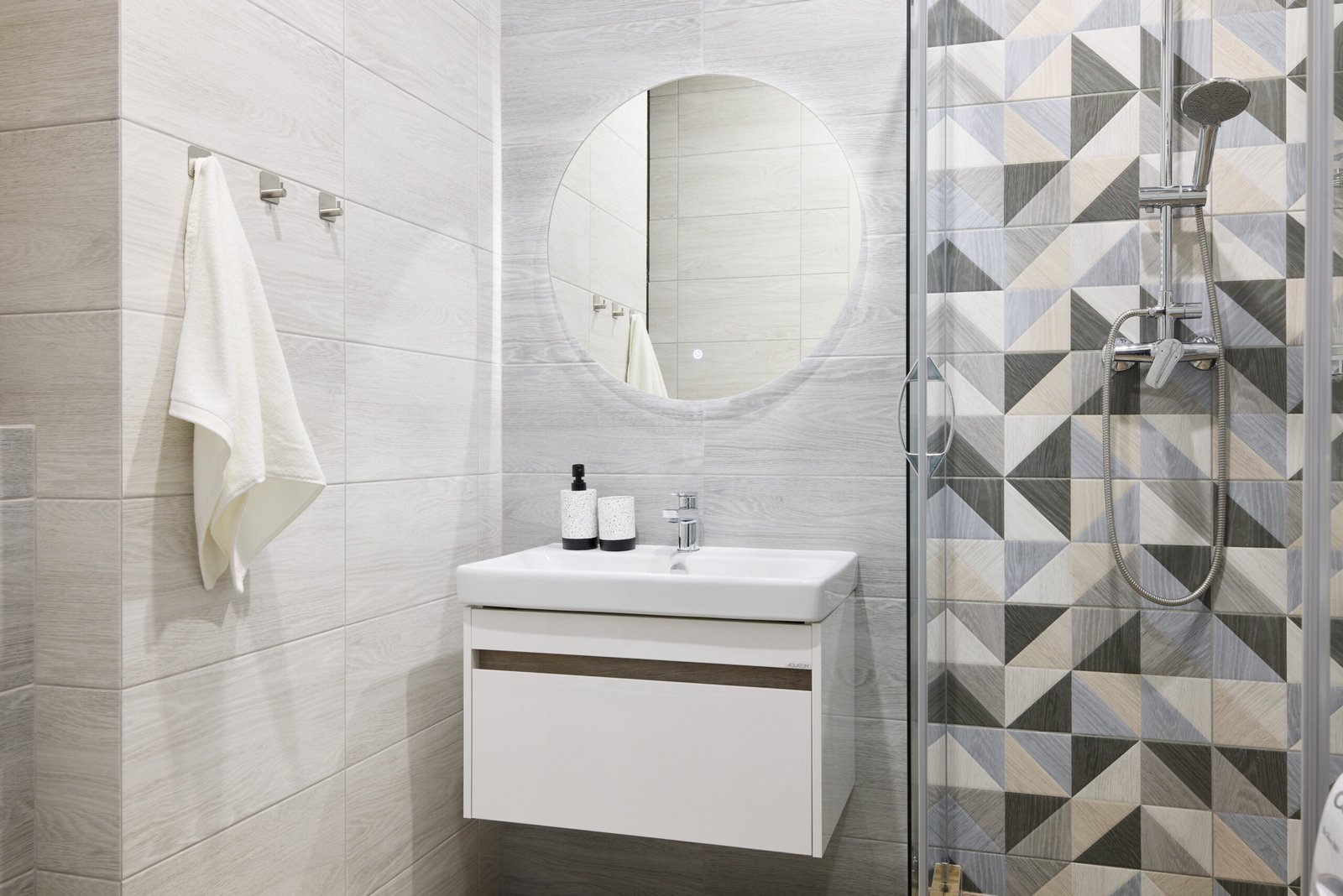
Let’s talk about small bathrooms.
Not the spa-like sanctuaries you see on Pinterest, with double vanities, walk-in rainfall showers, and hidden storage for days. I mean real small bathrooms. The kind where you can touch the sink, the toilet, and the shower without moving your feet. The kind where opening a cupboard door blocks the entrance to the room. The kind where one extra bottle of shampoo seems to tip the whole room into total chaos.
Small bathrooms are some of the hardest spaces to keep organised because they combine three things that do not play nicely together:
- Moisture (which ruins many materials).
- Daily Use (high traffic/high urgency).
- Zero Storage (often just a pedestal sink and a toilet).
You need easy access to essentials, but you also need the space to feel clean and calm. When storage fails here, bottles pile up on the rim of the bath (the “slime ring” zone), towels end up draped over radiators, and the room feels permanently messy—even when it is technically clean.
The problem isn’t that you own too much stuff. It’s that small bathrooms amplify every bad storage decision. There is no buffer. No spare corner. No place for clutter to hide.
Good vertical bathroom storage ideas aren’t about squeezing in more furniture. It’s about using Verticality, Optics, and Flow. Here is how to make a small bathroom work harder without making it feel smaller.
1. The “Floating” Principle (Protect the Floor)
In a small bathroom, the floor footprint is tiny—often less than 3 square metres. Any furniture that sits directly on the floor “eats” that space visually.
The Physics of Perception: Human brains judge the size of a room by how much floor area we can see. If you cover the floor with a laundry basket, a bin, and a chunky cabinet, the brain registers the room as “tiny.”
The Fix:
- Wall-Mounted Everything: Swap freestanding cabinets for wall-mounted ones. Choose a “floating” vanity unit instead of a pedestal or floor-standing cupboard.
- Elevate the Accessories: Screw the toilet brush holder and the bin to the wall (hotel style).
- The Cleaning Benefit: Bathrooms generate dust and hair. Furniture legs create traps for this debris. Floating furniture allows you to mop the entire floor in one swipe, keeping the room more hygienic.
2. Verticality: The “Ladder” Strategy
Small bathrooms rarely have spare width, but they almost always have unused Height. Standard bathroom ceilings are 2.4m high. Most people stop storing things at 1.5m (eye level).
Reclaim the “Upper Atmosphere”:
- The “Over-the-Toilet” Zone: This is the most wasted vertical space in the house. Install a shelving unit or a cabinet here.
- The “Above Door” Shelf: There is usually 30–40cm of dead space above the door frame. Install a shelf here for spare towels or bulk toilet roll. You don’t see it when you are in the room, so it adds zero visual clutter.
- Tall & Thin: A cabinet that is 30cm wide but reaches the ceiling holds double the volume of a standard wide cabinet, but takes up half the floor space.
3. The 20cm Depth Rule
Depth is the enemy in small bathrooms. A standard kitchen cabinet is 60cm deep. A standard bedroom chest is 45cm. In a bathroom, anything deeper than 20–25cm will feel intrusive. It will block your elbows when you are trying to dry your hair or brush your teeth.
The “Slim-Profile” Strategy: Aim for storage that hugs the wall.
- Slim Mirrored Cabinets: Look for units that are only 10–15cm deep. They are perfect for single rows of bottles (no digging to the back).
- Radiator Shelves: If you have a radiator, install a shelf directly above it. It utilizes the “dead air” above the heater without sticking out further than the radiator itself.
4. Containment: Opaque vs. Clear
Loose items create “Visual Noise.” Bottles, tubes, razors, cotton pads, hair ties—they are all different shapes and colours. When they sit loose on a shelf, they look like garbage.
The Containment Fix:
- Group by Function: Daily skincare, hair tools, dental care, First Aid.
- Opaque Bins: In a small space, I recommend opaque (solid colour) bins over clear ones.
- Why? Clear bins show the mess inside. If your makeup is messy, a clear bin just frames the mess. A white or woven bin hides it completely, making the room feel calmer.
- Material Science: Avoid wicker or untreated wood in a damp bathroom (it attracts mold). Use plastic, acrylic, or treated bamboo.
If you’re looking to stash things away under a pedestal or vanity but working with the awkward plumbing, these under sink storage ideas help reclaim space without blocking access.
5. The “Stockpile” Ban (Humidity Kills)
One of the biggest space killers is storing “Backups” in the bathroom. You do not need three bottles of shampoo and a 12-pack of toilet roll next to the sink.
The Biology Factor: Bathrooms are hot, humid, and have fluctuating temperatures. This environment actively degrades many products.
- Medication: Humidity breaks down pills.
- Perfume: Heat alters the scent.
- Razor Blades: Steam causes rust (oxidation) even on unused blades.
The Rule: Keep only the active item in the bathroom. The backups live in a cool, dry place (linen cupboard, bedroom wardrobe). This cuts your storage needs by 50%.
6. Mirrors: The Optical Illusion
Mirrors are essential in small bathrooms, but they should be working harder. A mirror does two things:
- Bounces Light: Making the room feel 2x bigger.
- Hides Clutter: If you choose a cabinet.
The Upgrade: Swap a flat mirror for a mirrored cabinet. Even a shallow cabinet (10cm deep) can hold your toothbrush, toothpaste, deodorant, and face cream. This clears the sink completely.
- Pro-Tip: If you can, recess the cabinet into the wall stud cavity. This gives you storage that is completely flush with the wall—the ultimate space saver.
7. The Physics of Drying: Hooks vs. Rails
Towel rails look neat in hotels, but in small homes, they often fail.
- The Problem: A standard towel rail takes up 60cm of wall width. If you have two people, you need two rails. You don’t have the space.
- The Result: You layer two towels on one rail.
- The Science: Towels need airflow to dry. If you layer them, moisture gets trapped between the fabrics, leading to bacterial growth and that damp, musty smell.
Hooks Win:
- Space Efficiency: You can fit four hooks in the space of one rail.
- Airflow: Hooks allow the towel to drape open, exposing more surface area to the air.
- The “Chimney Effect”: Install hooks high up (where the air is warmer) to speed up drying.
8. The Sink: The “Splash Zone”
The sink is the visual centre of a small bathroom. When it’s cluttered, the entire room feels messy. From a hygiene perspective, the area around the sink is the “Splash Zone.” Toothbrushes left out here are exposed to airborne bacteria (from the toilet flushing) and soapy water splashes.
The Rule: Clear the Perimeter.
- Store daily items inside a drawer or cabinet.
- Limit the counter to Hand Soap Only.
- If you have no storage under the sink, install a small shelf strictly for the toothbrush cup, mounted on the wall off the counter surface. This makes wiping the sink down takes 5 seconds instead of 1 minute.
If drawers around the sink are part of the problem, these bathroom drawer organisation ideas show how to keep daily essentials visible without letting them spill onto the counter.
9. Lighting Temperature (Visual Weight)
You might not think of light as storage, but poor lighting makes clutter look heavier. Shadows in corners make the room feel claustrophobic.
The Fix:
- Colour Temperature: Use “Daylight” or “Cool White” bulbs (3000K–4000K). Warm yellow light (2700K) can make a small bathroom feel dingy.
- Shadow Ban: Add an LED strip light under a cabinet or above the mirror. Eliminating shadows makes the walls feel further away.
10. The 80% Rule (Breathing Room)
It is tempting to Tetris every single inch of a small bathroom with storage. Don’t.
A bathroom filled to 100% capacity has no flexibility. One new product, one guest towel, or one travel bag—and the clutter spills out instantly. Aim for 80% Full. Leave one shelf partially empty. Leave space in the drawer. That “Negative Space” is what keeps the system stable over time. It allows you to breathe.
Final Thoughts
A small bathroom doesn’t need expensive renovations or magic tricks. It needs Restraint.
It needs you to respect the humidity, protect the floor space, and rigorously edit what belongs there. When storage is lifted off the floor, when surfaces stay clear, and when only active items live in the room, the bathroom stops feeling like a cage and starts feeling like a sanctuary.
Start with one fix: Clear the sink perimeter. That single change will change the energy of the room immediately.
1 thought on “Vertical Bathroom Storage Ideas That Make Tight Spaces Work Harder (Without Feeling Cramped)”