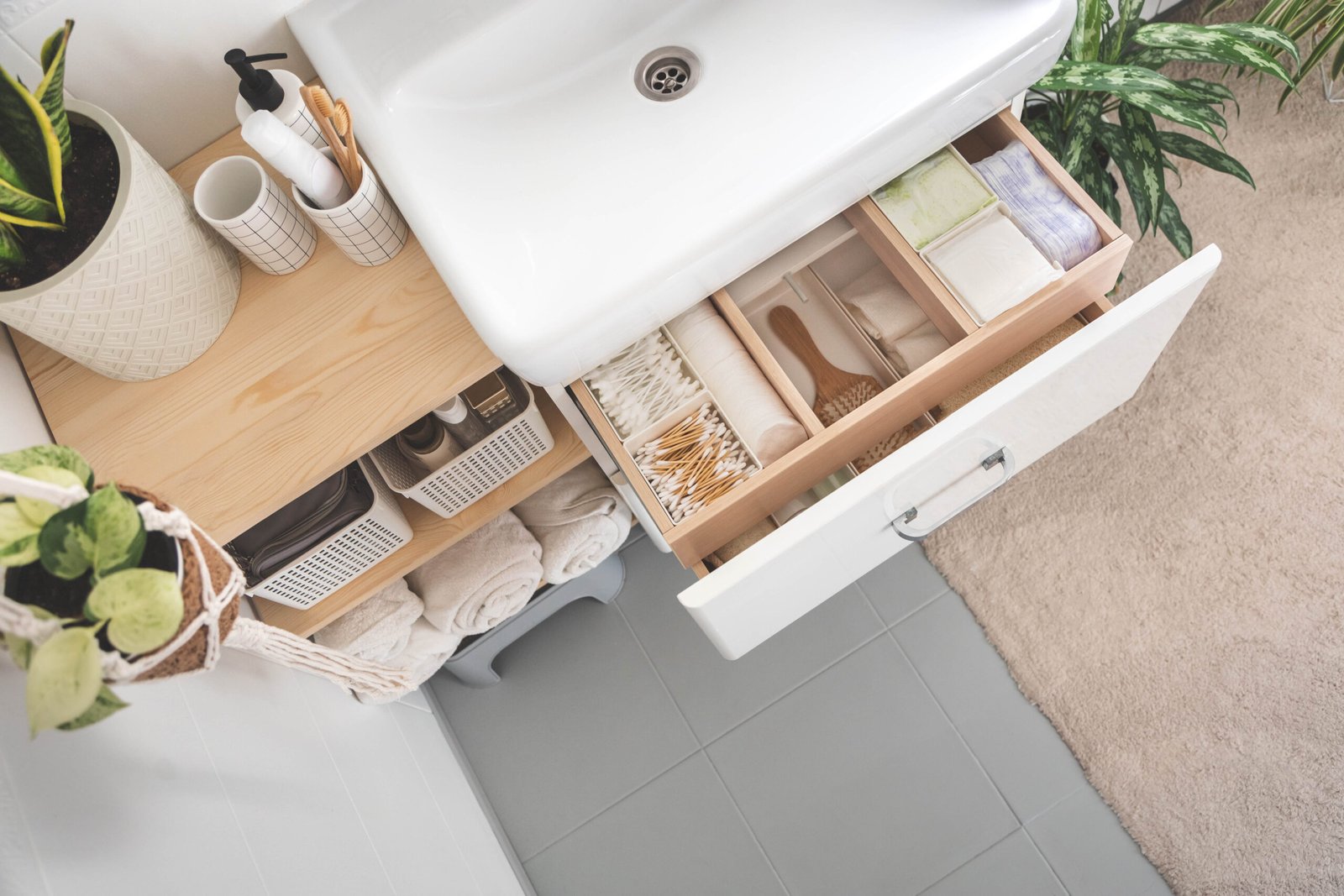
Let’s talk about the space under the bathroom sink.
Specifically, let’s talk about that awkward, hostile void full of pipes, U-bends, shut-off valves, and mysterious damp patches that turns even the most organised person into a shover. You know the type: you open the door, shove the toilet roll in, and close it quickly before something falls out.
In small bathrooms, the under-sink cupboard (or “vanity”) is often the only real storage you have. And yet it is usually the worst-used space in the room.
- Bottles tip over on the uneven floor.
- Cleaning sprays leak and ruin the wood.
- Toilet rolls get damp and puffy.
- You forget what is at the back, buy duplicates, and eventually give up trying to keep it tidy at all.
The problem isn’t that under-sink storage is useless. It’s that most people treat it like a normal cupboard. It isn’t one.
Under-sink spaces are irregular, interrupted, and humid. If you don’t design for those three realities, the space will always fail.
Good under sink storage ideas for small bathrooms aren’t about maximising volume at all costs. It’s about Access, Containment, and working around the plumbing instead of fighting it.
Under-sink organisation is only one piece of the puzzle—if the rest of the room is fighting you, these small bathroom storage ideas will help you create space throughout the entire bathroom.
1. The Anatomy of the Enemy (Map the Pipes)
The fastest way to fail is pretending the pipes aren’t there. Every under-sink area has a P-Trap (the U-shaped bend that stops sewer gas coming up) and usually two Shut-Off Valves (hot and cold water).
These split the cupboard into awkward geometrical zones. If you try to force square drawer units into this non-square space, you will lose.
The Strategy: Before buying anything, grab a tape measure and map the “Negative Space.”
- The “U” Zone: The space directly under the pipe is usually only 10–15cm high.
- The “Wings”: The vertical space to the left and right of the pipe. This is your prime real estate.
- The “Floor”: Is it flat? Or is there a lip at the front of the cabinet?
Once you accept that the centre is largely unusable for tall items, you stop trying to put bottles there.
2. The U-Shaped Drawer (or Shelf)
If you are renovating or installing a new vanity, buy a unit with a U-shaped drawer cutout. This wraps around the pipe, turning dead space into usable storage.
If you are renting or stuck with an existing cabinet, you can fake this.
- The Expandable Shelf: You can buy plastic under-sink shelving units that have removable slats. You remove the slats where the pipe goes, allowing the shelf to wrap around it.
- The Benefit: This instantly creates a second level of storage. You can put short items (sponges, soap bars) on the top shelf, and tall items (bleach, shampoo) on the bottom.
3. Containment: Bins Beat Stacking (Always)
Loose bottles under a sink are guaranteed chaos. They fall over like dominoes. If one leaks, it spreads to the others.
The Fix is Modular Bins. Use narrow, deep bins (acrylic or plastic) rather than wide boxes.
- Why Narrow? You can fit a narrow bin into the “Wings” (the space beside the pipe). You can slide it out like a drawer.
- Why Solid Sides? Deep Research Note: Do not use wire baskets here. If a bottle leaks in a wire basket, it ruins the cabinet floor. If it leaks in a solid plastic bin, it is contained. It saves your furniture.
Categories:
- Bin 1: Cleaning Products.
- Bin 2: Hair Tools.
- Bin 3: Toiletries Backups.
- Bin 4: First Aid.
4. Verticality: The Pull-Out Organiser
If your cupboard is deep but narrow, items at the back are lost forever. You need to bring the back to the front.
The Tool: The Sliding Tiered Organiser. These are metal or plastic units on runners.
- The layout: Usually a narrow top shelf (to miss the pipe) and a wide bottom shelf.
- The function: You pull the handle, and the whole unit slides out.
- The capacity: In a tiny bathroom, a 20cm-wide pull-out can store 10 cleaning bottles in a space that used to hold 3.
Renter Tip: If you can’t screw runners into the base, use heavy-duty command strips on the bottom of a freestanding organiser to stop it tipping when you pull it.
If your sink unit includes drawers rather than doors, many of the same principles apply—especially the friction and visibility rules used in these bathroom drawer organisation ideas.
5. The “Backup” Ban (Humidity Control)
Under-sink cupboards are damp. Cold water pipes often “sweat” (condensate) in humid bathrooms. This makes the under-sink area a terrible place for:
- Toilet Roll: It absorbs moisture and gets puffy/moldy.
- Powder Cleaning Products: They clump into bricks.
- Cardboard Boxes: They go soggy and attract silverfish.
The Rule: Only Active items live under the sink. One spare bottle of shampoo is fine. The Costco 12-pack belongs in the linen closet or a dry room.
6. Door Storage (The Lightweight Zone)
The inside of the cupboard door is valuable real estate, but it is structurally weak. Bathroom vanity hinges are often small. If you hang a heavy caddy filled with glass bottles, the door will sag.
Keep it Light.
- Adhesive Caddies: Stick a plastic caddy to the door for sponges, magic erasers, or lightweight cloths.
- Hair Tool Holster: A Command hook loop can hold a hair dryer (if the cord is light).
- Trash Bag Dispenser: Mount a dispenser for small bin liners.
7. Height Zoning: Heavy Low, Light High
Under-sink cupboards feel unstable when heavy items sit high up on flimsy shelves.
Gravity is your friend.
- Bottom Floor: Heavy liquids (Bleach, floor cleaner, litre bottles of shampoo).
- Upper Shelf/Bins: Light items (Sponges, cotton pads, razor blades, travel toiletries).
This reduces the “tipping risk” when you are fumbling for something in a rush.
8. Chemical Safety (The Separation Rule)
In a small bathroom, we tend to shove all the cleaning products together. Safety Check:
- Never store Bleach and Ammonia (often found in window cleaners) touching each other. If they leak and mix, they create toxic chloramine gas.
- Segregate them into different bins.
- Child Safety: If you have kids, the under-sink cupboard is the most accessible danger zone. Use a magnetic lock (which is invisible from the outside) on this door specifically.
9. Labels Prevent “The Drift”
Under-sink storage is usually shared by the whole household. When people don’t know where something goes, they put it “wherever there is a gap.”
Labels are for behaviour, not aesthetics. You don’t need fancy cursive script. A simple piece of masking tape on the bin saying “HAIR” or “CLEANING” is enough. It stops your partner putting the toilet duck in the face cream bin.
10. The 30-Second Reset
Under-sink cupboards collapse because they are annoying to fix. You have to crouch down on the floor to tidy them.
Design for Laziness. If resetting the space takes more than 30 seconds, you won’t do it.
- Ensure bins slide out smoothly.
- Ensure lids are optional (open bins are easier to throw things into).
- Keep the floor of the cabinet lined with a waterproof mat. If something spills, you pull the mat out and rinse it, rather than scrubbing the wood.
Final Thoughts
Under-sink storage in a small bathroom doesn’t need to be Instagram-perfect. It needs to be Forgiving.
Once you stop fighting the pipes, contain the clutter in waterproof bins, and limit what lives there to “active” items only, the space becomes quietly useful instead of perpetually frustrating.
Start by removing everything. Check for leaks. Then add one bin on the left, one bin on the right. That simple “Zone” structure is usually enough to fix the chaos.
2 thoughts on “Under Sink Storage Ideas for Small Bathrooms That Actually Work (Even With Pipes in the Way)”