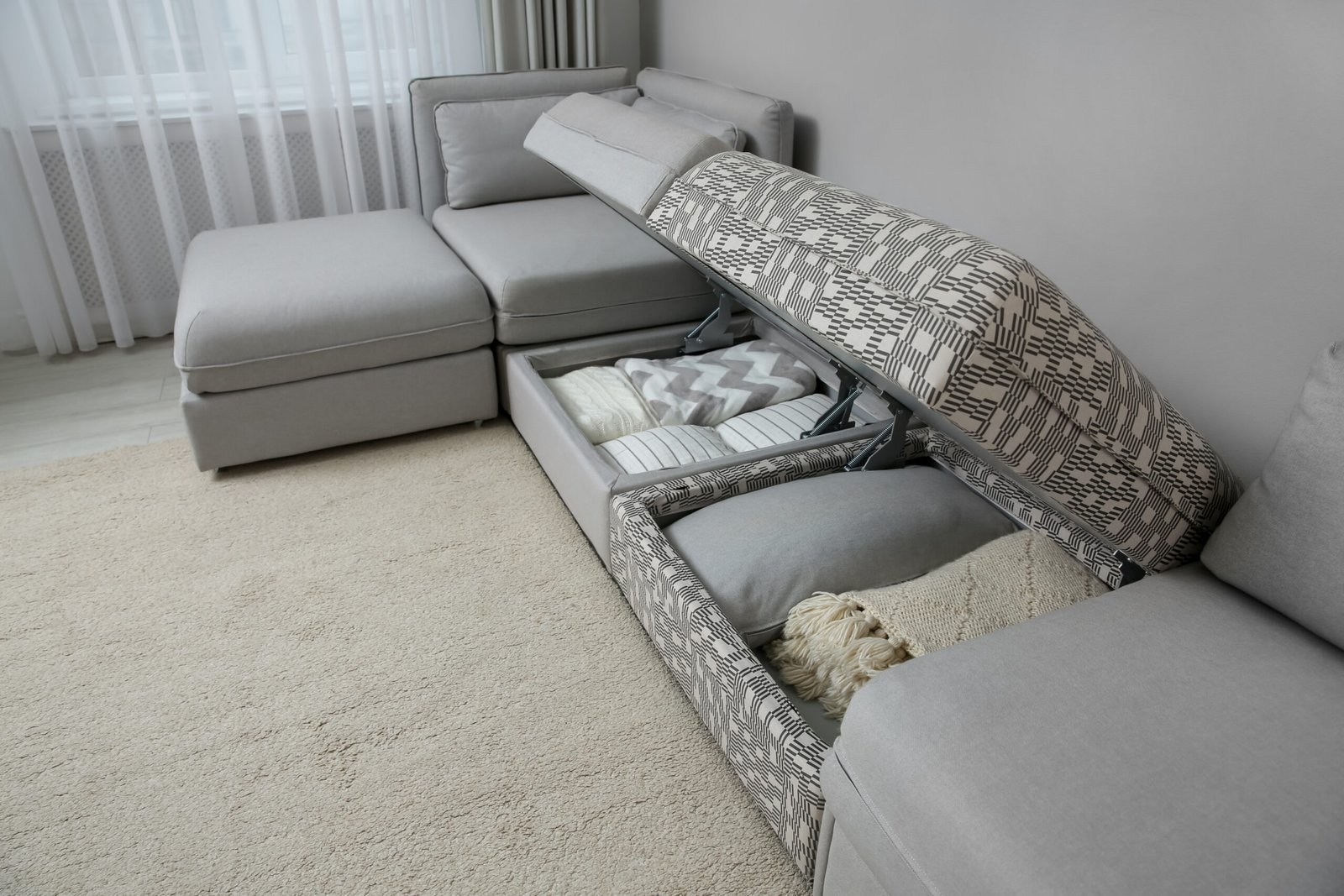
Let’s talk about storage ideas for homes with no loft or garage.
Not the aspirational property shows where the host casually waves a hand and says, “We’ll just put the Christmas tree in the garage for now,” or “You can always board out the loft for the suitcases.”
I mean the reality many UK households face: a modern new-build flat, or a converted period property, with no loft access, no garage, no basement, and barely any built-in cupboards. Every single thing you own must live inside the visible footprint of your daily life.
- Suitcases have nowhere to disappear to.
- Christmas decorations sit at the bottom of the wardrobe all year.
- DIY tools live in a kitchen drawer next to the tea towels.
- The hoover migrates between corners like a sad, plastic roommate you can’t evict.
If your home also lacks built-in cupboards, these storage ideas for flats with no built-in cupboards show how to build storage systems from scratch.
When a home has no loft or garage, you lose what architects call “Bulk Storage Zones.” These are the hidden pressure valves that absorb bulky, seasonal, and rarely used items. Without them, your everyday living space starts carrying the burden.
The solution is not squeezing more furniture into your rooms. It is deliberately engineering hidden capacity into the structure of your home.
Here are practical storage ideas for homes with no loft or garage that create space where absolutely none appears to exist.
1. The Horizontal Micro-Loft (Ottoman Physics)
The largest unused volume in most homes sits directly under the bed. Yet many people use standard slatted bed frames with thin legs, leaving the space beneath completely wasted or filled with dusty, loose bags. In homes without lofts or garages, this is an expensive mistake.
The Upgrade: The Gas-Lift Ottoman Bed. Ottoman beds lift the entire mattress upward.
- The Physics: They use pressurised gas struts (often around 600N of force), meaning you can easily lift a heavy mattress with one hand.
- The Volume: A UK King-size ottoman bed provides roughly 700 to 800 litres of storage capacity. That is the equivalent of three large chests of drawers, completely hidden from view.
- The Mechanics: Unlike drawer beds, ottomans require zero surrounding floor clearance to open, making them ideal for tight bedrooms.
What to store here: This is your new loft. Suitcases, winter coats, spare duvets, and the Christmas tree. Use vacuum-sealed bags to compress soft items, doubling your capacity and protecting fabrics from dust.
2. The “Russian Doll” Suitcase Protocol
Suitcases are the number one item people struggle to store without a loft. They are massive, rigid blocks of empty air.
The Fix: Never store an empty suitcase.
- Nest them: Buy luggage in sets of three so the cabin bag fits inside the medium bag, which fits inside the large bag.
- Fill the core: The innermost suitcase should never be empty. Use it as a hard-shell storage unit for your absolute least-used items—ski gear, sentimental childhood clothes, or deep-winter blankets. You have just turned a hollow plastic shell into a functional storage box.
3. Sell the Airspace (The Perimeter Shelf)
Look around your living room or bedroom. Now look up. Standard UK ceilings are about 2.4m high. Human eye level is around 1.5m to 1.6m. That means the top 40cm of your room is largely invisible to you on a daily basis.
The Architectural Hack: Install a continuous, heavy-duty perimeter shelf around the top of a room, sitting roughly 30–40cm below the ceiling.
- The Dimensions: A standard cardboard archive box is 25cm tall. A 35cm gap allows you to slide these boxes in perfectly.
- What it holds: Tax returns, memory boxes, old photo albums, and seasonal décor.
Because the shelf sits above your natural sightline, the room still feels open and wide, yet you have added hundreds of litres of “loft style” storage right above your head.
4. Fake the Garage (The “Utility Wardrobe”)
Garages normally house the messy, practical maintenance items: the vacuum cleaner, the toolbox, the ironing board, and the mop. Without a garage, these items scatter across multiple cupboards and create daily friction.
The Fix: Dedicate one tall, vertical piece of furniture entirely to utility storage. A single slim wardrobe frame (e.g., a 50cm x 50cm footprint) is enough.
- The Layout: * Top shelf: Cleaning products, spare bulbs, batteries (keep hazardous liquids high).
- Middle shelf: The toolbox and drill.
- Bottom void: A standard cylinder vacuum requires about 40cm x 40cm of floor space. Leave the bottom completely open so you can roll it straight in.
- Side panel: Mount a heavy-duty hook internally for the ironing board (which is usually 150cm tall when folded).
Once these items have a single, enclosed home with a door you can shut, they stop haunting your living spaces.
If you’re converting a wardrobe into a utility cupboard, our wardrobe storage ideas guide shows how to organise shelves and rails efficiently.”
5. Furniture That Secretly Swallows Volume
In homes without external storage, every piece of furniture must perform double duty. A coffee table with four legs and a glass top is a wasted opportunity.
Look for furniture with internal voids:
- Storage Ottomans: A large upholstered footstool can hold over 100 litres of blankets, board games, or children’s toys while functioning as comfortable seating.
- Lift-Top Coffee Tables: The top pulls up toward you (great for eating on the sofa), revealing a deep tray underneath for laptops and remote controls.
- Hallway Benches: A bench with a lift-up lid hides 10 pairs of shoes and umbrellas, keeping the entrance clear.
6. The Slim Cabinet Strategy (The 20cm Rule)
In tight homes, bulky furniture blocks walkways and makes rooms feel cramped. Standard furniture is 40–50cm deep. If you put that in a narrow hallway, you destroy the circulation zone (humans need about 80–90cm to walk comfortably).
Go Slim:
- Tip-out shoe cabinets: These are brilliant because they store shoes vertically. They are only 17–22cm deep, meaning they hug the wall almost like a radiator.
- Narrow bookcases: A paperback book only needs 15cm of depth. Don’t buy a 30cm deep bookshelf; it just gathers dust in front of the books.
- Between-stud storage: If you are renovating, you can recess shallow cabinets into the drywall cavities between the wooden studs (which are usually 10cm deep)—perfect for spice racks or bathroom medicines.
7. Visual Compression (The Match-Matchy Rule)
When you don’t have a garage, a lot of your storage has to be visible on open shelves. A mixture of cardboard boxes, clear plastic tubs, and woven baskets forces your brain to process dozens of different colours, textures, and shapes. This causes cognitive fatigue. It feels messy, even if it is technically tidy.
The Fix: Visual Compression. Choose identical, opaque storage boxes for any open shelving. If you have eight identical white boxes, your brain reads them as “one architectural block” rather than “eight distinct objects.” It creates immediate visual calm and hides the chaotic, brightly coloured items (like cables or dog toys) inside.
8. The 80% Capacity Buffer
Homes without lofts or garages cannot operate at 100% capacity. If every cupboard, box, and under-bed space is packed completely tight, the system becomes rigid.
The Physics of Friction: If you have to move three things just to put one thing away, the friction is too high. You will simply leave the item on the kitchen counter instead.
- You must leave a 20% buffer.
- Keep one shelf half-empty. Keep one drawer with space in it.
That empty space acts as a pressure valve for daily life. It absorbs the wet umbrella, the unexpected parcel delivery, or the coat of a visiting guest without tipping your home into chaos.
Final Thoughts
Living in a home with no loft and no garage can feel restrictive at first. But the secret is not trying to magically recreate those spaces—it is redistributing their jobs across the house.
You turn your bed into the loft. You turn a slim wardrobe into the garage. You turn the top 30cm of your walls into the archive zone.
Once storage is intentionally engineered into the very structure of your furniture, the absence of a garage stops feeling like a limitation, and simply becomes a highly efficient way of living.
Would you like me to review the next article on your list, or would you like to explore how we can link these articles together into a content cluster?
2 thoughts on “Storage Ideas for Homes With No Loft or Garage (When There Is Literally Nowhere to Hide Things)”