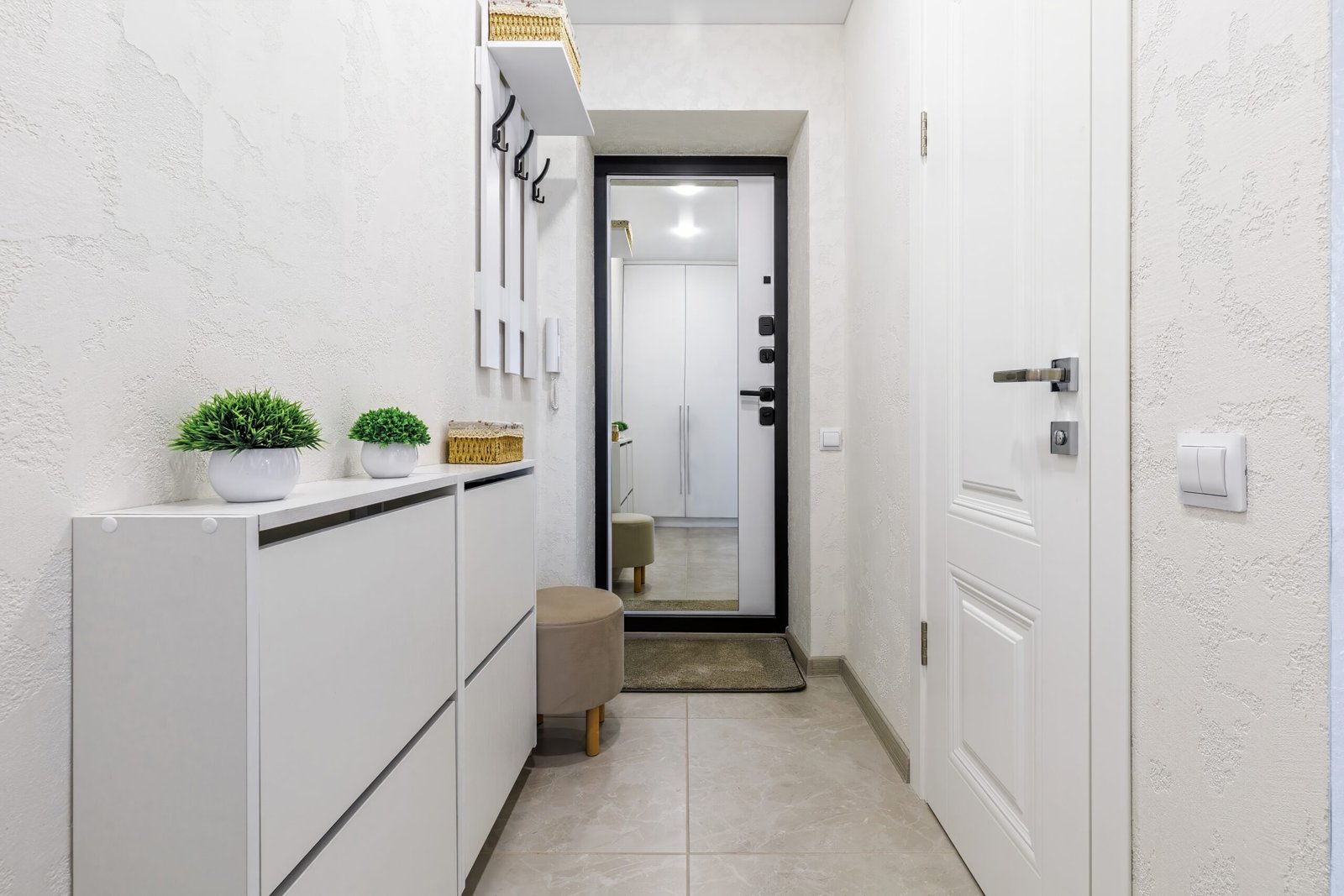
Let’s talk about hallways.
Specifically, small hallways. The narrow Victorian corridors. The cramped apartment entryways. The kind where you instinctively turn sideways to let someone pass, breathing in as you do it. The kind where opening a door blocks the entire walkway, trapping whoever is behind you.
Hallways are some of the most awkward spaces in a home. They aren’t rooms you spend time in—they are “Transitional Zones.” You pass through them dozens of times a day, but you never stop. Because of this, they often get ignored during storage planning.
So, they become Chaos Corridors.
- Shoes line the skirting board like a tripwire because there’s nowhere else to put them.
- Coats hang from the back of doors until the hinges protest and groan.
- Bags slump against the wall, gathering dust bunnies.
- Random items get “parked” there temporarily—and then never move again.
The problem isn’t just that hallways are small. It’s that they are expected to hold too many things without any structure. We treat them like storage units, when actually they are thoroughfares.
Good small hallway storage ideas aren’t about squeezing furniture into a tight space. They’re about choosing the right kind of storage—storage that respects movement, sightlines, and human laziness.
Hallways often overlap with entryways, which is why many of these principles also apply to entryway storage ideas—especially when shoes, coats, and bags all collide in one tight space.
Here is how to make a small hallway work harder without turning it into an obstacle course.
1. The Prime Directive: The 90cm Rule
This is non-negotiable. If your hallway feels stressful, it’s usually because the “walking line” is compromised.
The Anthropometrics of Stress: The average human shoulder width is about 45–50cm. To walk comfortably without feeling claustrophobic, you generally need a clearance width of 80–90cm (approx 3 feet).
If you place a 40cm-deep cabinet in a 100cm-wide hallway, you have left only 60cm of walking space. You have turned your home into a squeeze.
- The Rule: Nothing should intrude into the main walking path.
- The Test: If you have to turn your body to walk past a piece of furniture, that furniture is too deep. Remove it.
Before adding storage, define an invisible “highway” down the middle of the hallway. Everything you install must live outside that zone—either flush to the wall or mounted above shoulder height.
2. Depth is the Enemy (Think in Slim Profile)
In small hallways, Depth matters infinitely more than Height. A unit that sticks out 35cm can feel overwhelming. A unit that sticks out 17cm often disappears visually.
The “High-Rise” Strategy: Prioritise slim-profile furniture that hugs the wall.
- Shoe Cabinets: Look for “Tip-Out” cabinets (like the IKEA Trones). They are only 18cm deep. They hold a surprising amount but intrude almost zero space into the room.
- Console Tables: Look for “radiator shelves” or ultra-slim consoles (15–20cm deep). You don’t need a deep table for keys; you just need a ledge.
- Wall-Mounted: Always mount furniture to the wall if possible. Seeing the floor underneath the unit creates an optical illusion of more space.
If you remember nothing else: Go Tall, Not Deep.
For homes with extremely tight corridors, these narrow hallway storage ideas focus specifically on keeping walkways clear.
3. Shoes: The Floor is Lava (Again)
Shoes are the fastest way to destroy a hallway. One pair looks lived-in. Five pairs look messy. Ten pairs constitute a fire hazard.
The mistake most people make is using a standard, open shoe rack.
- Why it fails: Open racks are usually 30cm deep. They block the walkway. Plus, looking at a pile of dirty soles is visual noise.
Better Options:
- Tip-Out Cabinets: As mentioned, these hide shoes vertically. It keeps the visual line clean.
- Vertical Tension Poles: These floor-to-ceiling poles have little “leaf” shelves for shoes. They take up a tiny footprint in the corner.
- The Strict Rotation Rule: Only the shoes you wear this week live in the hallway. The hiking boots you wear twice a year? They go to the bedroom wardrobe or the under-bed storage.
If shoes are the main source of hallway clutter in your home, these shoe storage ideas go deeper into solutions for tight, awkward spaces.
4. Hooks Beat Cupboards (The Friction Factor)
In small hallways, cupboards often fail. Why? Door Swing. If you have a narrow hallway, opening a cupboard door blocks the path. It requires you to step back, open the door, step forward, hang the coat, step back, close the door. That is too much friction. You won’t do it. You’ll just drop the coat on the banister.
Hooks Win.
- Immediate Access: No doors to open.
- Zero Footprint: A hook sticks out 5cm.
- Spacing: Don’t bunch hooks together. Space them 20cm apart so coats don’t bulk up into a massive ball of fabric.
Pro-Tip: Use “Acorn” style hooks (hooks that curve back in) rather than sharp hooks, to prevent snagging clothes as you brush past in the narrow space.
5. Utilize the “Air Rights” (Above Door Storage)
Most small hallways have high ceilings (especially in older UK properties), yet we waste all that vertical space.
Look at the space above your internal doors. There is usually 30–50cm of wall space there.
- The High Shelf: Install a simple shelf running the length of the hallway, above head height.
- What to store: Baskets of seasonal items (hats/gloves in summer, beach towels in winter), spare lightbulbs, or books.
- Safety: Use a shelf with a “lip” or front edge so nothing slides off onto your head.
This is “Dead Space” reclamation at its finest.
6. Mirrors That Multitask
Mirrors are the oldest trick in the book for small spaces because they bounce light and fake depth. But in a small hallway, a mirror needs to earn its keep.
Don’t just hang a flat mirror.
- Mirror + Shelf: Look for mirrors with a built-in ledge at the bottom. It acts as your “Landing Strip” for keys and lip balm.
- Mirror Cabinet: A shallow bathroom-style mirror cabinet works brilliantly in a hallway. It hides keys, wallets, and sunglasses behind the glass, keeping the look clutter-free.
- The “Check Point”: A mirror gives you that final “teeth check” before you leave. It adds function.
7. The “Landing Strip” (Contain the Chaos)
Every hallway needs a landing zone. If you don’t create one, your hallway will create one for you—usually the floor, or the top of the radiator.
In a narrow space, this must be minimal.
- The Floating Shelf: A tiny shelf (even 10cm deep) mounted at waist height.
- The Tray: Place a small tray or bowl on the shelf.
- The Psychology: Loose keys look messy. Keys in a bowl look intentional. It creates a boundary. “The mess stops here.”
8. Bags Need Parking (Not Slumping)
Bags are bulky. Backpacks, tote bags, and gym bags have a habit of “slumping” against the wall, taking up valuable floor width.
Solutions:
- The “High Hook”: Heavy-duty hooks mounted high up for backpacks.
- The “Side of Cabinet”: If you have a shoe cabinet, put a sticky hook on the side of it for a tote bag.
- The “One Bag Rule”: Hallways are not bag storage. Only the bag you are using today lives here. The collection of 15 tote bags needs to go to the kitchen or cupboard.
9. Lighting is Storage (Sort of)
You might not think of light as storage, but in a small hallway, shadows are clutter. Dark corners hide mess. A dimly lit pile of shoes looks like a mountain.
- Wall Sconces: Don’t use floor lamps; they steal floor space. Use wall lights.
- Motion Sensors: Consider a battery-operated motion sensor light for inside cupboards or dark corners. Being able to see the space makes you more likely to keep it tidy.
- Warmth: Use warm white bulbs (2700K). Harsh white light makes a small space feel like a hospital corridor; warm light makes it feel like a home.
10. The “Radiator Cover” Hack
In the UK, many hallways are blocked by a single, ugly radiator. It takes up space and does nothing (except heat).
The Fix: A Slim Radiator Cover.
- The Ledge: It gives you a console table surface for keys and mail without drilling into the wall.
- The Look: It hides the ugly metal fins.
- The Safety: It stops coats from resting directly on a hot radiator.
11. Less is More (The Paradox)
Sometimes, the best way to organise a small hallway is to remove storage.
If you try to make a 3-foot wide hallway hold coats, shoes, sports gear, the dog lead, the mail, the umbrellas, and the recycling… it will fail. No amount of clever IKEA hacking will fix a physics problem.
The Strategy:
- Relocate: Move the coat rack to the back door? Move the shoe storage to the bedroom?
- Acknowledge: Accept that your hallway is a corridor, not a room. Keep it clear.
Final Thoughts
Small hallways don’t need clever tricks. They need restraint.
Clear the walking path. Keep storage slim (under 20cm). Use walls instead of floors. When the hallway works, the whole home feels calmer. You arrive without stress. You leave without scrambling. And that narrow, awkward space finally starts doing its job quietly in the background.
4 thoughts on “Small Hallway Storage Ideas That Make Narrow Spaces Work Harder (Without Feeling Cluttered)”