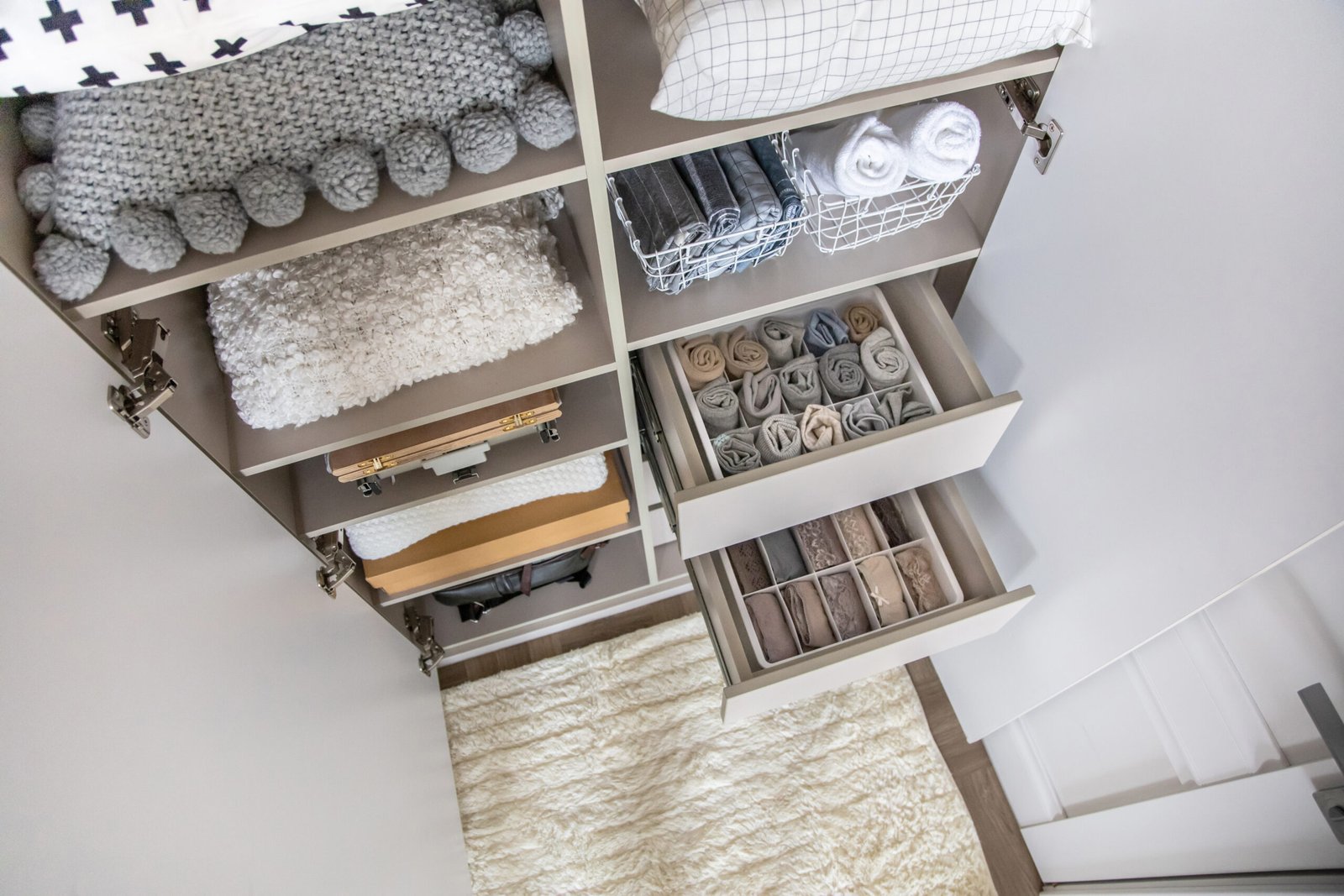
Let’s talk about wardrobes in small bedrooms.
Not the walk-in closets with islands, velvet-lined jewellery drawers, and mood lighting that you see on “Dream Home Makeover.” I mean the real ones.
The single standalone unit crammed wall-to-wall in a box room. The sliding doors that stick halfway and jump off the track if you look at them wrong. The wardrobe that came with the rental flat and smells faintly of the previous tenant’s aftershave. The one where opening the door feels like triggering a slow-motion clothing avalanche.
In small bedrooms, the wardrobe carries an unfair amount of pressure. It is expected to hold everyday clothes, shoes, bags, coats, spare bedding, the vacuum cleaner, and sometimes things that have nothing to do with clothing at all (like a guitar or a stack of paperwork). If the entire room feels cramped, start with broader small bedroom storage ideas before refining the wardrobe itself.
When wardrobe storage fails in a small room, the consequences spill outward immediately.
- Clothes migrate to the chair.
- Shoes line the skirting board, creating a trip hazard.
- Laundry baskets multiply.
- Mornings feel rushed and chaotic because you are physically fighting your furniture to find a pair of socks.
The problem isn’t necessarily that your wardrobe is too small (though it might be). The problem is that most wardrobes are sold as “Empty Boxes.” They have one high rail and one shelf. That layout wastes about 40% of the cubic volume.
Small bedroom wardrobe storage ideas aren’t about magic. They are about Geometry, Tension, and Editing. Here is how to make a small wardrobe work like it’s twice the size—without knocking down walls.
And if you’ve already decluttered but the layout still isn’t working, structured wardrobe organisation ideas make a bigger difference than buying more boxes.
1. The Volume Calculation (Physics Wins)
Before you buy a single storage gadget, you have to accept the physics of the situation. A standard single wardrobe is 90cm wide. You cannot fit 12 months’ worth of clothing into 90cm of rail.
The “Active Wardrobe” Rule: Your small wardrobe should only contain clothes you could realistically wear in the next 4–6 weeks.
- The “Buffer Zone”: Everything else (heavy winter coats in July, flimsy sundresses in December) needs to move to “Deep Storage.”
- Vacuum Bags: Vacuum bags are ideal for off-season clothing — especially when combined with smart under bed storage ideas that keep bulk out of the wardrobe entirely.
- The Result: By removing the “dormant” 30% of your clothes, the “active” 70% suddenly has room to breathe. Organisation without editing is just compression. And compression always rebounds.
2. Double the Rail (The “Dead Air” Hack)
Most small wardrobes waste a criminal amount of vertical space. A standard rail is positioned 160cm off the floor. A standard shirt or blouse hangs down about 70–90cm. That leaves 60–70cm of empty air underneath your shirts.
The Fix: A Rail Extender. You can buy a “hanging closet rod” that hooks onto your main rail and hangs down, providing a second rail below.
- Top Rail: Shirts, blouses, jackets.
- Bottom Rail: Trousers (folded over), skirts, shorts.
- The Benefit: You have instantly doubled your hanging capacity without drilling a single hole. This is rental-friendly gold.
3. Shelf Dividers: Stop the “Fabric Slump”
Wardrobe shelves are notorious for collapsing into chaos. You fold your jumpers in a neat stack. You pull one out from the middle. The stack leans. Two days later, it is a jumbled pile.
The Fix: Acrylic or Wire Dividers. These slide onto the shelf and act like bookends for your clothes.
- Why they work: They provide structural support. A stack of jeans cannot fall over if it is wedged between two dividers.
- The Limit: Don’t stack higher than 25cm. Any higher, and the friction makes it too hard to pull items out.
4. The 35cm Depth Rule (For Shoes & Bags)
Most standard wardrobes are 60cm deep (to accommodate a hanger). However, folded clothes and shoes are rarely that deep. If you line shoes up at the bottom, there is a “dead zone” behind them.
Utilize the Back 20cm:
- Shoe Risers: Instead of putting shoes flat on the floor, use stackable shoe racks. This uses the vertical space at the bottom.
- The Back Wall: If you can reach it, put command hooks on the back wall of the wardrobe (behind the hanging clothes) to store tote bags or belts. They hang flat and don’t take up rail space.
5. Drawer Inserts (Create Structure)
If your wardrobe doesn’t have drawers, you need to build them. Loose underwear and socks floating on a shelf is a disaster.
The Solution:
- Plastic Drawer Units: Measure the bottom of your wardrobe carefully. Buy a plastic 3-drawer unit that fits underneath your hanging clothes.
- Fabric Boxes: If you have shelves, use structured fabric boxes.
- The Method: One category per box. (e.g., “Socks,” “Gym Kit,” “Swimwear”).
- Label It: If the box is opaque, label the front. You will forget what is inside.
6. The Hanger Upgrade (Friction Matters)
This sounds superficial, but in a small wardrobe, it is structural. Mismatched hangers are bulky. Wooden hangers are thick (2cm). Plastic tube hangers are slippery.
Switch to Velvet Slimline Hangers.
- The Maths: A velvet hanger is 0.5cm thick. A wooden hanger is 2cm. If you have 50 items, switching to velvet saves 75cm of horizontal rail space. That is huge.
- The Friction: Velvet grips the fabric. Clothes don’t slip off and pile up on the floor.
- The Look: Visual uniformity makes the wardrobe look less cluttered, which reduces that “overwhelmed” feeling when you open the door.
7. The Door is a Load-Bearing Surface (With Caution)
If you have a hinged door (not a sliding one), the inside of the door is usable space. But be careful of weight. Wardrobe hinges are often weak. Do not hang heavy coats here.
Use it for “Lightweight Overflow”:
- Over-Door Organisers: Fabric pockets for scarves, gloves, sunglasses, or clutches.
- Dressing Gown: Install a single hook for your robe (which is bulky and takes up too much rail space).
- The “Next Day” Hook: A hook for planning tomorrow’s outfit.
8. Lighting (The Dark Corner Problem)
Small, crammed wardrobes are dark. If you can’t see the black t-shirt at the back, you won’t wear it. Or worse, you will buy another one.
The Fix:
- Motion Sensor LEDs: Stick a battery-operated LED strip to the underside of the shelf above the rail.
- The Effect: It lights up when you open the door. You can see everything. It feels like a boutique, not a cave.
9. The “Floor” Gap (The Shoe Graveyard)
The floor of a wardrobe is often a shadow zone where dust bunnies and single shoes go to die. Things get pushed back. Laundry hides there.
The Rule: Nothing sits directly on the wardrobe floor loose.
- Containment: Use a designated bin for laundry, or a shoe rack.
- Pull-Out Factor: If you store storage boxes on the floor, make sure they have handles so you can drag them out easily.
10. Leave Breathing Room (The 80% Rule)
A wardrobe filled to 100% capacity will always fail. If you have to physically shove a hanger aside to make space for another one, the system is broken. The friction is too high. You will stop hanging clothes up.
Aim for 80% Capacity. There must be:
- A tiny gap between hangers.
- A partially empty shelf.
- A free hook. That “buffer” absorbs new purchases and laundry returns.
Final Thoughts
Small bedroom wardrobe storage isn’t about magic gadgets. It’s about Volume Management.
It’s about reducing the bulk (vacuum bags), layering vertically (double rails), and containing the chaos (boxes and dividers). When your wardrobe stops fighting you, mornings get faster. The “Chair of Doom” disappears. And your small bedroom starts feeling like a room again, instead of a holding pen for clothes.
Start with one change: The Rail Extender. It costs very little, installs in seconds, and instantly doubles your space.
2 thoughts on “Wardrobe Storage Ideas for Small Bedrooms That Actually Fit Real Clothes (Not Just Pinterest Dreams)”