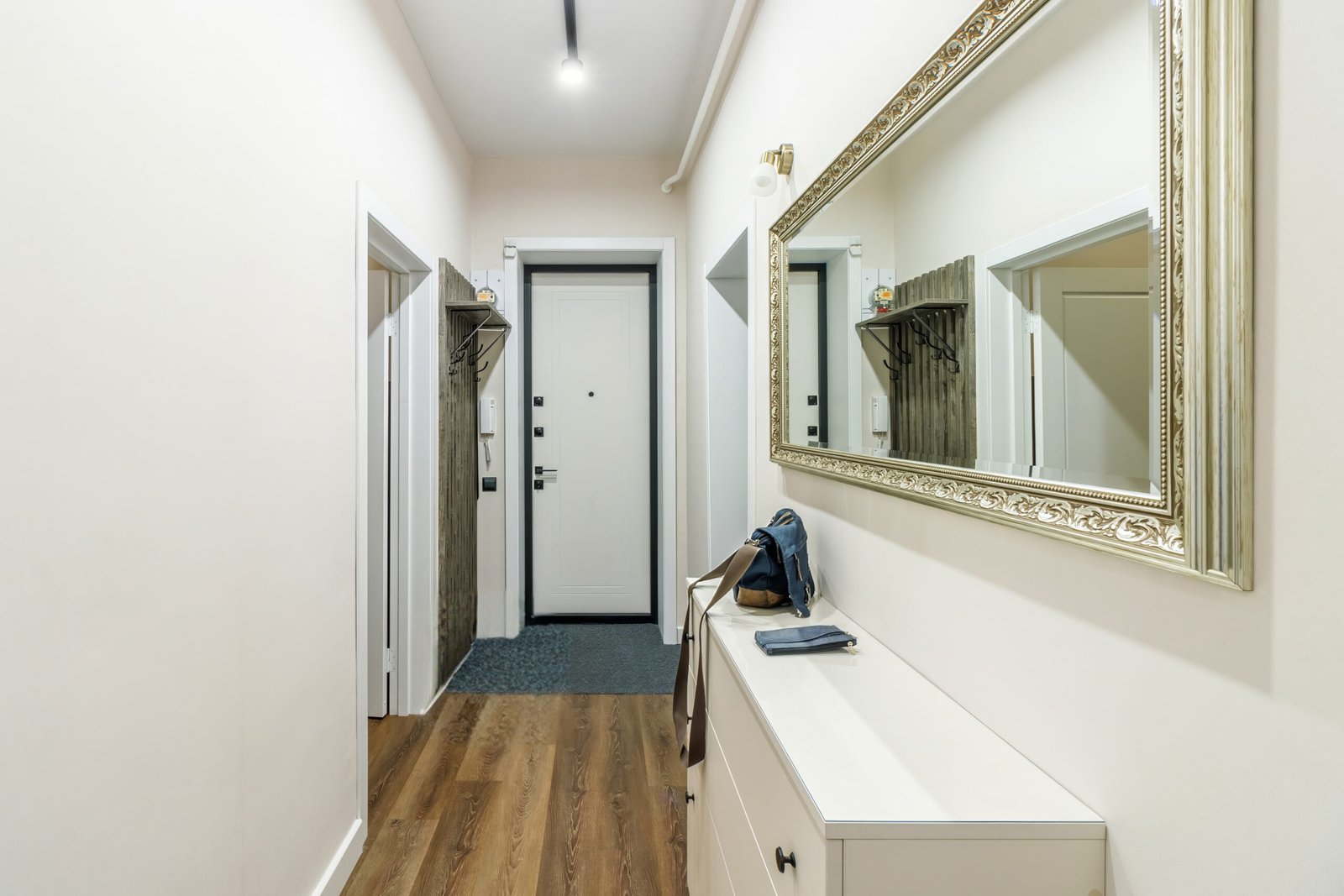
Let’s talk about narrow hallways.
Not the wide, light-filled corridors you see in renovation shows, where there’s room for a console table, a bench, a fiddle leaf fig, and still space to stride through dramatically.
I mean real narrow hallways. The Victorian terrace corridor. The modern apartment entry. The kind where two people can’t pass without one flattening themselves against the wall like a cartoon character. The kind where opening a door turns the space into a temporary dead end. The kind where one badly placed shoe rack turns your daily life into a low-level obstacle course.
Narrow hallways are some of the most unforgiving spaces in a home. They are pure Circulation Zones. You don’t linger. You don’t relax. You move through them dozens of times a day—often in a rush, often carrying groceries, often half-awake.
And yet, we keep trying to make them behave like rooms.
- We add deep furniture that bruises our hips.
- We let shoes creep along the skirting board.
- We allow “temporary” items to pile up until the hallway becomes a choke point.
The result isn’t just visual clutter. It’s Friction. It’s that constant, quiet irritation that comes from a space that slows you down every single day.
In flats, the hallway (or lack of one) becomes even more important — you have to manufacture your own entry zone. For. ore information on utilising these spaces, our storage ideas for flats with no storage has what you need.
Good narrow hallway storage ideas aren’t about fitting more in. It’s about respecting movement. If the storage interferes with how you walk, it doesn’t matter how clever it is—it’s wrong.
These principles build on the broader thinking in our main guide to hallway storage ideas, but focus specifically on spaces where width is severely limited.”
Here is how to add storage to a narrow hallway without blocking walkways or turning your home into a squeeze.
1. The Physics of the “Shuffle” (The 90cm Rule)
Before you add a single hook, you need to understand the math of movement.
Anthropometrics: The average human shoulder width is about 45–50cm. To walk normally, we need “sway space.”
- Comfortable walking width: 90cm+.
- “Tight” walking width: 80cm.
- “The Shuffle” width: Anything under 75cm requires you to turn your body.
The Test: Measure your hallway width. Subtract 80cm. Whatever is left is the maximum depth of furniture you can install. If your hallway is 100cm wide, you have 20cm of play. If you buy a 35cm deep console table, you have broken the flow of the house.
The Rule: Everything you add must either sit completely flush to the wall or live above shoulder height.
2. Depth Is the Real Enemy
In narrow hallways, Depth matters far more than width or height. A tall unit that is shallow is invisible. A short unit that is deep is a stumbling block.
This is why so many “hallway” furniture pieces fail—they are often just repurposed bedroom or living room furniture (usually 40–50cm deep) shoved into the wrong context.
The Sweet Spot: You need to look for Ultra-Slim furniture (under 20cm).
- Radiator Shelves: In the UK, a radiator shelf is a classic hack. It deflects heat into the room and creates a landing strip for keys that is only 15cm deep.
- Picture Ledges: Use IKEA Mosslanda picture ledges as shelves. They are only 12cm deep—perfect for leaning mail, sunglasses, or small framed photos.
The same principles apply in garages too — especially in narrow UK builds. Our small garage storage ideas guide explains how to protect walking space around vehicles.
3. The “Tip-Out” Shoe Solution
Shoes are the biggest culprit in blocked walkways. Even a neat row of shoes lined up against the skirting board eats about 25–30cm of floor width. That is a massive chunk of your walkway.
Open racks fail here. They expose the visual clutter and usually stick out too far.
The Fix: Vertical Tip-Out Cabinets. These cabinets store shoes vertically (toes pointing down) rather than flat.
- The Depth: They are usually only 17–22cm deep.
- The Visuals: They hide the shoes completely behind a clean flat front.
- The Bonus: They have a top surface that acts as a console table for keys.
- The Safety: Because they are so slim and tall, you must screw them to the wall.
4. Door Swing Dynamics (Hooks Beat Cupboards)
Cupboards seem tidy in theory, but in narrow hallways, they create a Blockage Event. If a cupboard door is 40cm wide, opening it blocks the entire corridor.
- You have to step back.
- Open the door.
- Step forward.
- Retrieve item.
- Step back.
- Close door.
You won’t do it. You will end up leaving the door ajar, which blocks the hall permanently.
Hooks Win. Hooks have almost zero depth and require zero clearance to use.
- Pro-Tip: Use “swivel hooks” or smooth, rounded hooks. In a narrow hall, you brush against the walls. Sharp hooks can snag your jumpers as you walk past.
If you’re renting and can’t screw hooks into the wall, these storage ideas for rented homes cover tension-based and adhesive alternatives.
5. Sell the “High Line” (Vertical Space)
If your hallway is narrow, the floor should stay as empty as possible. The more floor you can see, the wider the space feels (this is called “visual floor extension”).
Look Up.
- The “Above Door” Shelf: Most hallways have dead space above the door frames. Install a shelf running the length of the hall high up. Use it for books or attractive storage boxes (for winter hats/scarves).
- The “High Rail”: Install a coat rail high up for long coats, keeping the bottom clear for boots.
6. The Minimalist “Landing Strip”
Hallways need a place for keys, wallets, and phones. If you don’t have one, you will dump them on the floor or the stairs. But in a narrow space, a standard console table is too big.
The Micro-Console:
- Floating Shelf: Install a small floating shelf (approx 30cm long x 15cm deep).
- The Tray: Add a specific tray or bowl.
- The Discipline: This surface is only for pocket contents. It is not for mail, parcels, or groceries. If the landing strip grows, the hallway shrinks.
If your hallway also functions as your front door drop zone, these narrow solutions pair well with the systems outlined in our entryway storage ideas guide.
7. Mirrors: The “Tunnel Effect” Breaker
Narrow hallways suffer from the “Tunnel Effect”—long, dark parallel lines that feel enclosing.
Mirrors break the tunnel.
- Positioning: Don’t just put a mirror at the end (which makes the tunnel look infinite). Put a large mirror on the side wall.
- The Optic Trick: It visually doubles the width of the hall.
- Function: Choose a mirror with a hidden cabinet behind it (like a bathroom cabinet). It gives you storage for keys and sunglasses with zero additional depth.
8. Bag Parking (The Snag Risk)
Bags are awkward. They slump. They sprawl. In a wide hall, you can put a basket on the floor. In a narrow hall, a basket on the floor is a trip hazard.
Get them off the floor.
- High Hooks: Hang backpacks flat against the wall.
- Side-Mounting: If you have a shoe cabinet, put a strong adhesive hook on the side of the unit. Hang the tote bag there. It utilizes the “dead space” at the end of the cabinet.
9. Lighting: Ban the Floor Lamp
A dim hallway feels narrower than it actually is. Shadows in the corners exaggerate the clutter. But you cannot use floor lamps—they take up precious floor space.
Wall-Mounted is Essential.
- Sconces: Wall lights draw the eye up and push the walls out visually.
- Recessed or Flush Mount: If you have low ceilings, keep the light fixture flush to the ceiling so it doesn’t loom over you.
- Warmth: Use warm light. Cool light in a narrow hall feels like a hospital; warm light feels like a tunnel of calm.
10. The Uncomfortable Truth (Relocation)
Sometimes, physics wins. Not every hallway can hold storage. If your hallway is less than 80cm wide, forcing storage into it will make your life miserable.
The “No Storage” Strategy:
- Move Shoes: They live in the bedroom or a utility cupboard.
- Move Coats: They hang on the back of the kitchen door.
- Acceptance: Accept that the hallway’s job is movement, not containment. A clear, empty hallway feels luxurious compared to a “cleverly stored” hallway that bruises your hip every time you walk through it.
Final Thoughts
Narrow hallways don’t need clever tricks. They need discipline.
When walkways stay clear, when storage hugs the wall (under 20cm), and when floor space is respected, the hallway stops feeling like a bottleneck.
You move through it without thinking. You don’t bump, dodge, or squeeze. And that quiet ease carries through the rest of the house. Start by removing anything that sticks out into the “Walking Line.” That single change usually fixes more than any new piece of storage ever could.
2 thoughts on “Narrow Hallway Storage Ideas That Don’t Block Walkways”