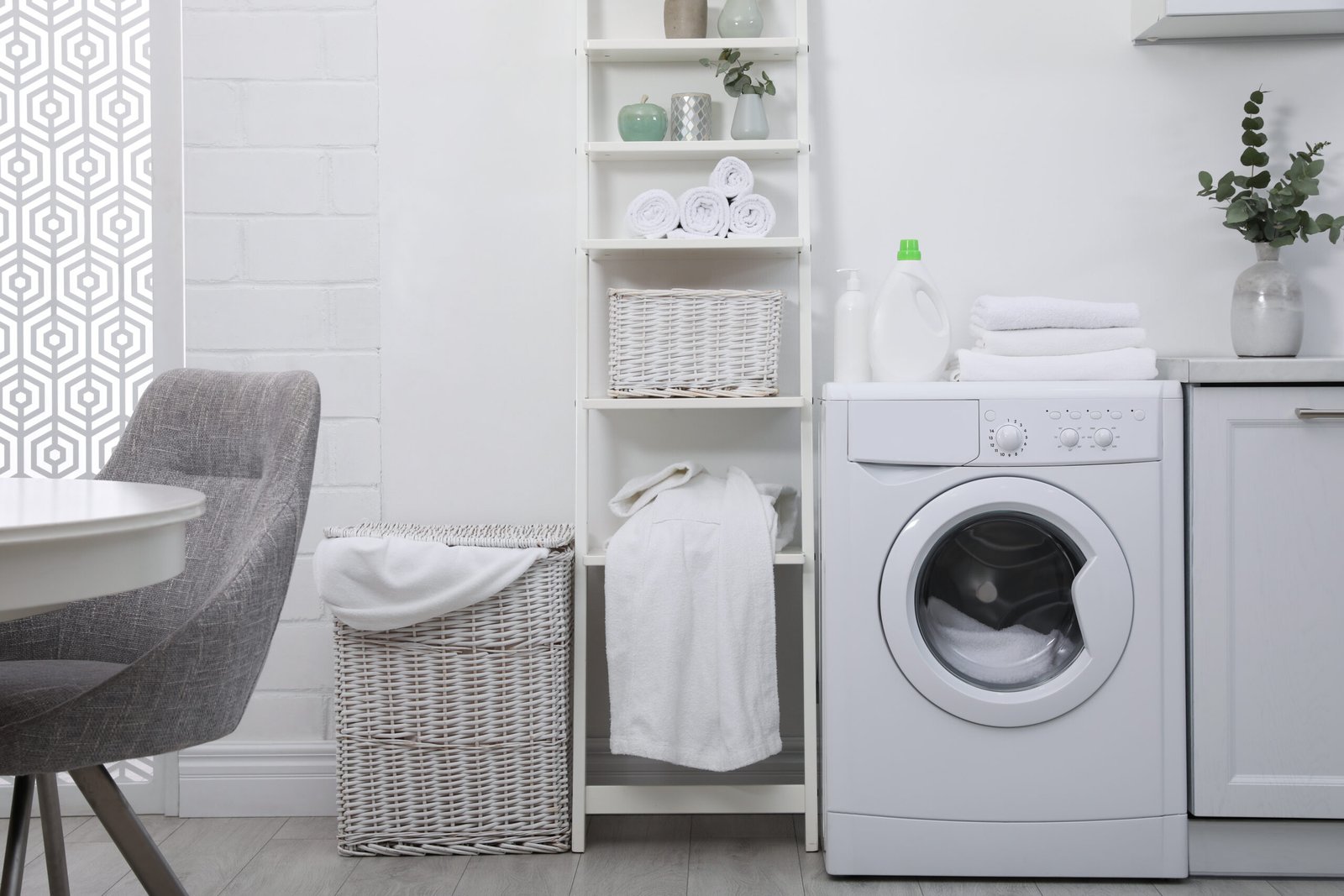
Let’s talk about laundry.
And no, I don’t mean the romantic, magazine version of laundry. I don’t mean the spacious, sun-drenched utility rooms with farmhouse sinks, subway tiles, and wicker baskets filled with perfectly folded, color-coordinated linen towels.
Let’s talk about real laundry.
The kind that lives in piles. The kind that migrates across rooms like a slow-moving fabric glacier. The kind that somehow feels endless, no matter how many loads you do.
For most homes, laundry doesn’t have a dedicated space. It happens in the kitchen while you’re trying to cook dinner. It happens in the bathroom where you’re trying to relax. Or it happens in a cupboard under the stairs that smells slightly of damp coats.
Because laundry often lacks a proper “home,” it becomes visual noise.
- Clean clothes sit unfolded in the basket for three days because there is nowhere to put them.
- Dirty clothes spill onto the floor because the hamper is full.
- And then there is the “Chair”—the place where clothes that are worn but not dirty go to die.
The problem isn’t that you are lazy. The problem is a lack of structure.
Good laundry storage isn’t about having a big room. It’s about controlling the “Flow.” Dirty → In Progress → Clean → Put Away. Once you organize that flow, the chaos stops multiplying.
Here are the best laundry storage ideas that actually work in real homes—especially small ones with limited space and busy people living in them.
1. Define Your “Zones” (The Traffic Control System)
Laundry feels overwhelming because it all blurs together. If you look at a pile on the floor, you often don’t know: Is that dirty? Is it clean? Is it the dog’s blanket?
If everything exists in one vague “Laundry Pile,” it will never stay under control. You need to zone your storage.
The Three Essential Zones:
- The Dirty Zone: This is the hamper. Nothing leaves here until it goes into the machine.
- The Clean Zone: This is the basket or shelf where dry clothes wait to be folded. (Crucially: This must be different from the Dirty Zone).
- The “Limbo” Zone: This is for clothes that have been worn once but aren’t dirty enough to wash (jeans, hoodies).
These can be baskets, bins, or hooks—but they must be separate. Once clothes have a clear destination at every stage, they stop drifting onto chairs, floors, and bed corners.
Without clear zones, spaces collapse into clutter — whether it’s laundry piles or a home office that bleeds into the rest of the house.
2. Stop Using the “Mega-Basket”
The single biggest laundry mistake most households make is using one enormous, deep laundry basket for everything.
The Physics of Failure:
- It gets too heavy to carry comfortably.
- To find a pair of socks, you have to dump the whole thing out.
- It encourages procrastination. (It takes a week to fill, which means you have to spend your entire Saturday doing five loads of washing).
The Solution: Pre-Sorting. Replace the Mega-Basket with smaller, divided hampers.
- Lights / Darks: If you sort as you throw, you save 10 minutes on wash day.
- Person A / Person B: If you have kids, give them their own hampers. When their hamper is full, their laundry gets done.
- The Benefit: Smaller loads feel manageable. Doing one small load on a Tuesday night is infinitely better than facing “Laundry Mountain” on Sunday.
3. The “Chair of Doom” Solution (In-Between Clothes)
Every home has The Chair. It’s the bedside chair, or the corner of the treadmill, or the end of the bed. It holds the jeans you wore for two hours. The hoodie you wore to the shops.
This is not a moral failure; it’s a system failure. You don’t want to put them back in the wardrobe (they aren’t perfectly clean), but you don’t want to wash them (they aren’t dirty). So they float.
Storage fixes for “In-Between” clothes:
- The Door Hooks: Install a row of hooks on the back of the bedroom door. This is your “Valet Station.” Jeans and hoodies hang here to air out.
- The Dedicated Basket: Have a specific, small basket labeled “Wear Again.”
- The Ladder Rack: A leaning ladder looks stylish and is perfect for draping outfits for the next day.
Rule: If it sits in the “In-Between” zone for more than a week, it goes in the wash.
4. Vertical Storage (Get It Off the Floor)
In a small bathroom or hallway, floor space is gold — especially when storage isn’t planned properly.
Go Vertical.
- Wall-Mounted Bags: You can buy canvas laundry bags that hang on the back of a door or on a wall hook. These are brilliant for kids’ rooms or tiny bathrooms. The bottom usually unzips to drop the clothes into the machine.
- Tall & Slim: Ditch the round, wide wicker basket. Get a “slimline” plastic or fabric hamper that fits into the narrow gap between the toilet and the wall.
- Stackable Bins: If you have a utility cupboard, use stackable recycling bins for laundry sorting. They go up rather than out.
5. Kitchen Laundry (The Stealth Approach)
In the UK and Europe, it is very common to have the washing machine in the kitchen. This presents a unique problem requiring some creative kitchen storage ideas – you don’t want your dirty socks next to your lasagna.
Kitchen Laundry Storage Ideas:
- The “Undercounter” slide: If you have a gap between appliances, use a slim rolling cart to hold detergents.
- Hidden Hampers: If you are renovating, install a “tilt-out” cabinet door that hides a wire laundry basket inside. It looks like a normal cupboard from the outside.
- Noise Control: Store your heavy detergent bottles on a shelf above the machine, not on top of it. The vibration of the spin cycle makes bottles rattle and fall, creating chaos.
6. The “Supply Kit” (Decanting vs. Reality)
Laundry detergent bottles are ugly. They are sticky. They are brightly colored.
To Decant or Not to Decant?
- The Aesthetic Route: Pouring liquids into glass jars looks beautiful on Instagram. However, glass jars are heavy and slippery. If you drop one on a tiled floor… disaster.
- The Practical Route: Keep the original bottles but hide them.
- The “Kit” Strategy: Don’t have stain remover on one shelf and softener on another. Put everything in a caddy (like a cleaning bucket).
- Detergent, softener, stain stick, mesh bags, color catchers.
- When it’s time to wash, you grab the whole kit. This is especially vital if your machine is in a basement or communal area.
7. Drying Solutions (The Eyesore Factor)
This is the hardest part of laundry storage. Wet clothes need to hang, but drying racks (airers) are notoriously ugly and take over the living room.
How to store drying clothes without ruining your decor:
- The “Sheila Maid” (Pulley): If you have high ceilings, install a pulley rack. You load the clothes, hoist them up to the ceiling (where the air is warmer), and they dry out of the way.
- Wall-Mounted Accordions: These racks bolt to the wall and fold flat when not in use. When you need them, you pull them out. Great for bathrooms.
- Over-Door Airers: These hook onto the top of a door and fold down. They are perfect for flats where floor space is non-existent.
- The Rule: Never leave the airer up when it’s empty. As soon as the clothes are dry, fold the airer and slide it behind the wardrobe or sofa.
8. Reduce Friction (Fold Where You Store)
Why do clean clothes sit in the basket for days? Because of Friction.
If you take warm clothes out of the dryer, pile them in a basket, carry them upstairs, put the basket on the floor, and walk away… you have broken the flow. The “Doom Pile” is born.
The Fix:
- Fold at the source: If you have space, fold the clothes immediately as they come out of the dryer.
- Fold into the drawer: Take the basket to the bedroom. Open the drawer. Fold one item and put it directly into the drawer. Do not make a pile on the bed first. Skip the middleman.
9. Shelving Beats Cupboards
For laundry, Open Shelving is often better than closed cupboards.
Why? Because laundry requires visual reminders. If you put a pile of ironing inside a cupboard, you will forget it exists for three months.
- Towels: Stack them on open shelves. It looks spa-like and you can see when you are running low.
- Supplies: Keep detergents visible so you know when to rebuy.
- The Clean Pile: If clean laundry is sitting on an open shelf, the visual clutter will annoy you enough to make you put it away. If it’s hidden in a cupboard, it will rot there.
10. The Weekly Reset
Laundry is a circle. It is never “done.” As soon as you finish, you are wearing clothes that will become dirty.
Accepting this is key to mental peace. Instead of aiming for “Empty Hampers Forever” (impossible), aim for a Weekly Reset.
- Sunday Night: Empty all baskets. Even if you don’t wash it all, sort it into the machine piles.
- Clear the “In-Between” Zone: Check the door hooks. Are those jeans actually dirty now? Wash them.
- Consolidate: Combine the random half-loads.
Final Thoughts
Laundry storage isn’t about creating a perfect, stylized room. It’s about managing the flow of fabric through your life.
When dirty clothes have a designated holding pen, clean clothes have a landing strip, and the “half-worn” items aren’t draped over the treadmill, the whole house feels calmer.
You don’t need a renovation. You just need two baskets instead of one, and maybe a hook on the back of your door. Start there.
1 thought on “Laundry Storage Ideas That Actually Work (Even If You Don’t Have a Laundry Room)”