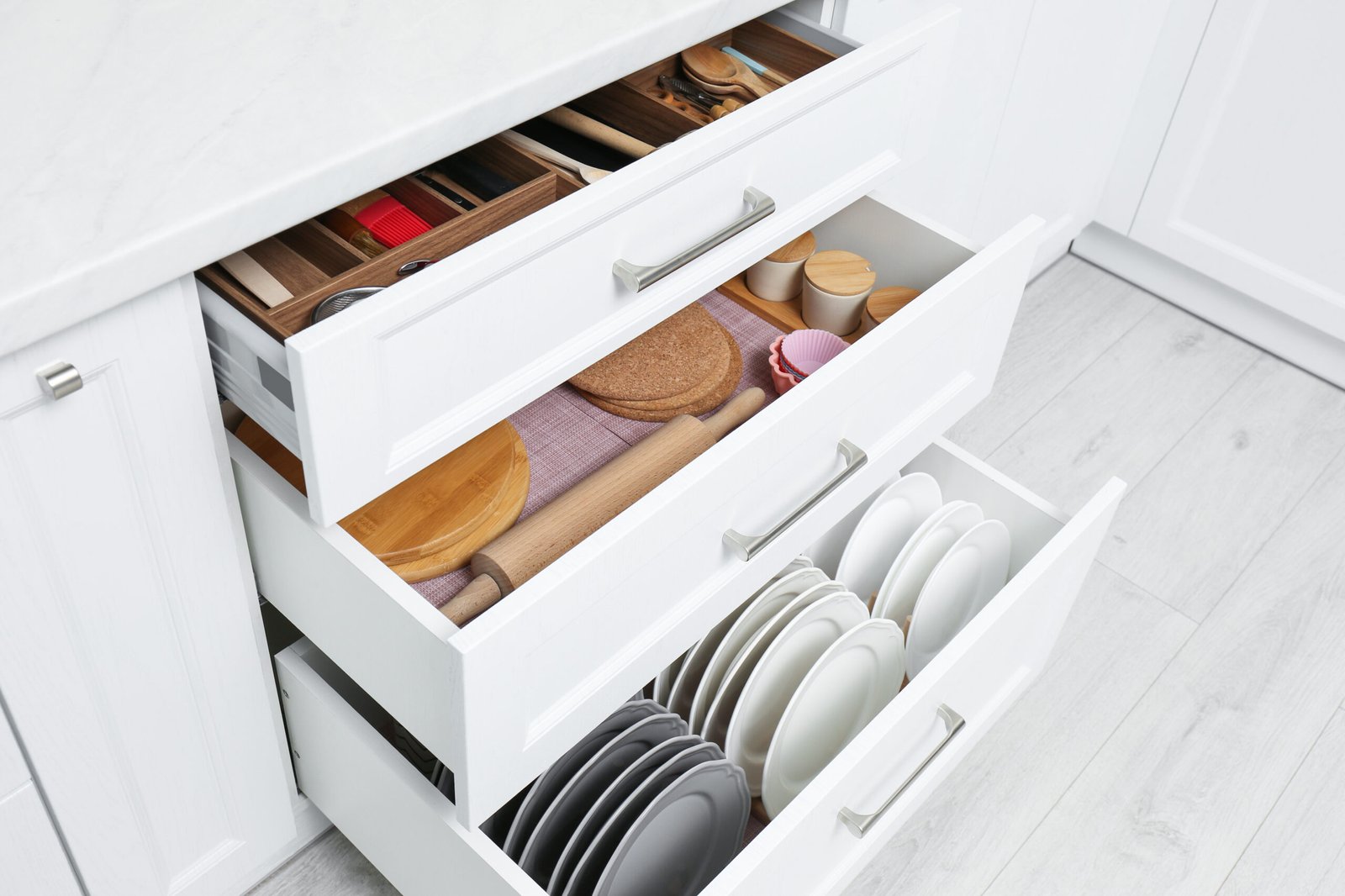
Let’s talk about kitchen drawers.
Specifically, the ones you open with confidence… and then immediately regret.
The drawer that sticks halfway because a ladle has hooked itself onto the cabinet frame, requiring you to perform a delicate surgical manoeuvre just to get it open. The utensil drawer where you know you own a potato masher, but it is currently buried under a layer of spatulas and tangled whisks. The “Miscellaneous” drawer (we all have one) that contains batteries, elastic bands, takeaway menus, a lighter you don’t remember buying, and a tape measure that only appears when you don’t need it.
Kitchen drawers are some of the most used storage in the house—and some of the least intentionally designed.
They fail not because you have too much stuff, but because drawers are deceptively hostile environments. It comes down to Physics. Every time you pull a drawer open, inertia pushes the contents backward. Every time you slam it shut, inertia throws the contents forward. This constant “sloshing” means that unless items are physically pinned down, chaos is inevitable.
Good kitchen drawer organisation ideas aren’t about buying pretty bamboo dividers and hoping for the best. They’re about managing Friction and Geometry.
Here is how to organise kitchen drawers so they open smoothly, make sense instantly, and stay organised long after the novelty wears off.
1. The Core Principle: Drawers Are Not Cupboards
A drawer is not just a cupboard laid on its side. Treating it like one is the fastest way to chaos. In a cupboard, gravity keeps things in place. In a drawer, movement is the enemy.
The Mindset Shift: Drawers work best when items are separated and immobilised. If you throw loose items into a big empty box, they will mix. You need to create “cells.”
- The Rule: Every item needs a specific slot that matches its size. A pizza cutter needs a different size slot than a teaspoon. If they share a slot, they will tangle.
2. Frequency Mapping (The “A-B-C” System)
Before you buy a single divider, empty the drawer completely. Group the contents by how often you touch them.
- The “A” Team (Daily): Cutlery, main chef’s knife, favourite wooden spoon, can opener.
- The “B” Team (Weekly): Measuring cups, whisks, baking spatula, grater.
- The “C” Team (Monthly/Yearly): Turkey baster, corn-on-the-cob holders, cake decorating tips, garlic press (be honest, do you use it?).
The Hard Truth: Why are “C” items occupying your top drawers? The most accessible drawers (waist height, near the hob or prep area) are VIP zones. Only the “A” Team lives here. Everything else must be demoted to lower drawers or cupboards. If you have to dig past a melon baller to get a fork, your system is broken.
Drawer organisation works best when it’s part of a wider system. If your drawers are tidy but your cupboards are chaos, food and tools still end up migrating—this is where good pantry organisation ideas make a big difference.
3. Stop the Slide: The Acoustics of Storage
Most drawer chaos is caused by sliding. Plastic dividers on smooth laminate drawer bases look tidy on day one, but they migrate by week two. Plus, there is the noise. The clatter of plastic on plastic is harsh.
The Fix: Friction & Sound Dampening.
- Cork Liners: This is the pro choice. Cork provides natural grip, so dividers don’t slide. Crucially, it creates a “soft landing.” When you drop a spoon in, it lands with a dull thud, not a clatter. It makes the kitchen feel more expensive.
- Rubberised Matting: The cheaper alternative. Look for “grip liner” with a waffle texture.
- Museum Putty: If you have individual small bins in a drawer, put a tiny blob of museum putty (or Blu Tack) on the bottom corners. They will never slide again.
4. Geometry Hack: The Diagonal Rule
Standard kitchen drawers are often 45–50cm deep. Standard utensils (ladles, rolling pins, bread knives) can be 30–40cm long. If you use vertical dividers, you often end up with a few inches of dead space at the back that is hard to reach.
The Fix: Go Diagonal.
- Place your long dividers diagonally across the drawer.
- Why? In geometry, the diagonal line (hypotenuse) is the longest line in a rectangle. You gain extra length for those awkward BBQ tongs or long bread knives.
- It also looks incredibly custom and stylish.
5. The “One Layer” Mandate
If you stack items in a drawer, you have already lost.
- Two layers = Hidden items.
- Hidden items = Forgotten items.
- Forgotten items = Buying duplicates.
The Rule: Every drawer must operate on a Single Visible Layer. If you look down and can’t see the item you need because it is under something else, the drawer is overfilled. Exception: Nested items like measuring spoons are allowed to stack, provided they clip together.
6. The “Utility” Drawer (Formerly “Junk”)
Every kitchen ends up with a junk drawer. The mistake is pretending it shouldn’t exist. If you don’t have a place for batteries and rubber bands, they will end up on the counter.
Rebrand it: The Utility Drawer. The goal isn’t elimination; it’s Micro-Containment.
- No Loose Items: Do not throw loose batteries in. They roll.
- Modular Bins: Use small, interlocking plastic bins (like Tetris blocks).
- Bin 1: Batteries.
- Bin 2: Tape and Scissors.
- Bin 3: Pens.
- Bin 4: Tools (Screwdriver/Allen keys).
- Quarterly Purge: Every three months, check this drawer. If you don’t know what a key belongs to, or if a coupon has expired, toss it.
7. Shallow Drawers: The Spice Flat-Lay
Shallow drawers (the top ones) are often wasted on random clutter because people think they “can’t fit much.” That shallow depth is actually a feature, not a bug. It forces discipline.
The Spice Hack: Instead of a spice rack that takes up counter space, use a shallow drawer.
- Buy matching square glass jars.
- Lay them flat in the drawer.
- Label the lid or the side facing up.
- Result: When you open the drawer, you see a perfect library of spices. No digging, no falling jars. It is visually stunning and incredibly functional.
8. Knife Safety (Protect Your Fingers)
Storing sharp knives loose in a drawer is a recipe for dull blades and cut fingers. Knife blocks on the counter are bulky and can collect bacteria.
The Solution: In-Drawer Knife Docks. These are blocks of cork, bamboo, or plastic with slots that sit inside the drawer.
- Safety: The blades are covered.
- Sharpness: The blade edge doesn’t bang against other metal utensils.
- Space: They hold 10+ knives in a compact row.
9. Task Zoning (Reduce Steps)
Don’t organise by “item type.” Organise by “Task.” Stop walking across the kitchen to get a spoon.
- Prep Zone Drawer (Under the chopping board): Knives, peelers, garlic press, measuring spoons.
- Cooking Zone Drawer (Next to the hob): Spatulas, tongs, wooden spoons, thermometer.
- Baking Zone Drawer: Rolling pin, cookie cutters, silicone spatulas, scales.
When drawers are task-based, your hands move less. The kitchen feels intuitive.
In smaller kitchens, drawer zoning becomes even more important because you don’t have spare cupboard space to compensate—smart small kitchen storage ideas help prevent overflow before it starts.
10. The “Chef’s Close” (Maintenance)
Drawers stay organised when the cost of resetting them is low. If fixing a messy drawer takes five minutes, you won’t do it. If it takes 10 seconds, you will.
The Ritual: At the end of cooking, when you are putting the clean utensils away:
- Don’t just drop them in. Place them in their slot.
- Straighten one divider if it has moved.
- Remove one item that doesn’t belong (e.g., the hair tie that fell in).
Tiny resets prevent total collapse.
Final Thoughts
A well-organised kitchen drawer doesn’t need to look Instagram-perfect. It needs to work.
It saves you time, irritation, and decision-making energy multiple times a day. When drawers open smoothly, when everything has a place, and when nothing jams or hides, cooking becomes less about fighting your environment and more about making food.
Start with the cutlery drawer. It’s the easiest win. Fix that friction point, and you’ll feel the payoff immediately.
And if your cupboards are just as frustrating as your drawers, these kitchen cupboard storage ideas show you how to fix deep, hard-to-reach cabinets.
3 thoughts on “Kitchen Drawer Organisation Ideas That Stop the Daily Digging and Jamming”