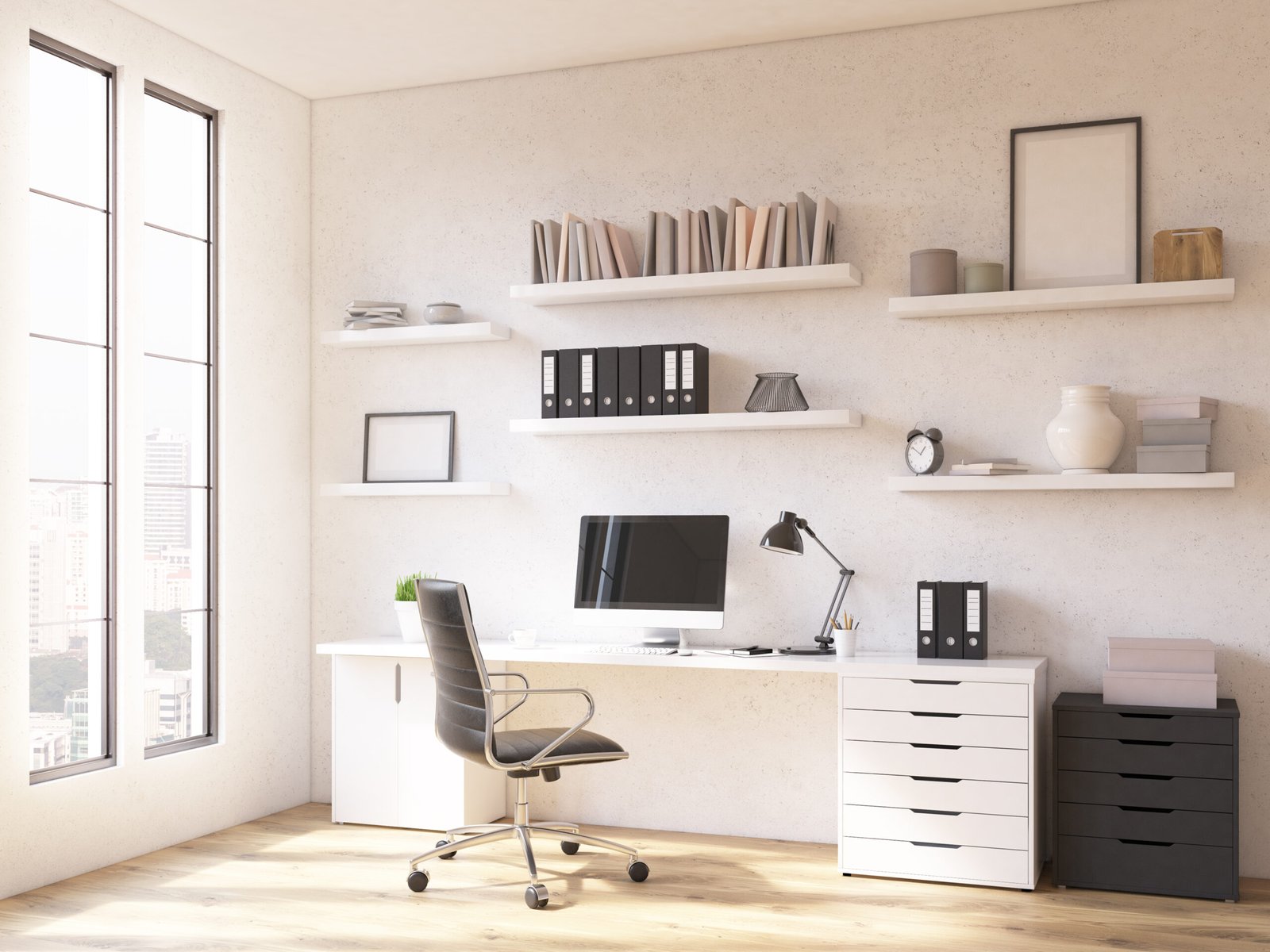
Let’s talk about home offices.
Specifically, let’s talk about the kind of home office most people actually have.
I don’t mean the ones you see on Instagram. You know the ones: a glass-walled studio overlooking a forest, a Herman Miller chair, a pristine white desk holding nothing but a MacBook Air, a single notebook, and a smug little succulent plant.
I mean the real home office.
The corner of the bedroom where the laundry sometimes piles up. The end of the dining table that has to be cleared off before dinner. The spare room that slowly became a dumping ground for cables, paperwork, half-used notebooks, and a printer you swear you still need but haven’t used since 2019.
You sit down to work at 9:00 AM, and before you’ve even opened your laptop, your brain is already tired. Why? Because there are papers everywhere. The desk feels cramped. You can’t find a working pen. There is a pile of “important stuff” that you keep moving from the left side of the desk to the right side, just to make room for your coffee.
Cluttered workspace, cluttered thinking.
The problem isn’t that you are a naturally disorganised person. The problem is that most home offices evolve accidentally. They are built reactively—one Amazon purchase, one stray cable, one stack of letters at a time—without a system.
Good home office storage isn’t about making the space look corporate. It’s about removing friction. It’s about creating a space where you can sit down and work without fighting your environment.
Here is how to organise a home office so it actually supports your focus, even if your “office” is just a desk in the corner of your life.
1. The Desk Is Not a Cupboard (The “Cockpit” Rule)
This is the most important rule of productivity.
Your desk is a work surface, not a storage unit.
If your desk surface is covered in staplers, tape dispensers, three notepads, a stack of mail, and a box of tissues, your brain treats them as “open tabs.” Even if you aren’t consciously looking at them, they create low-level visual noise that drains your focus.
The Clear Desk Protocol: Only items used daily are allowed to live on the desktop. Usually, that list is very short:
- Laptop / Monitor.
- Keyboard & Mouse.
- One notebook.
- One pen.
- A drink.
Everything else—the hole punch, the external hard drive, the reference books—needs to earn its place. If you use it once a week, it does not belong on the desk. It belongs in a drawer or on a shelf. It should be within arm’s reach, but out of your direct line of sight.
Visual noise can be plaque in many areas of the home and is a key consideration when organising your entryway.
2. Drawer Structure (Stop the “Junk Drawer” Slide)
Desk drawers fail for the same reason bathroom drawers do: they are empty boxes.
If you throw a pen, a USB stick, a charging cable, and a pack of gum into an empty drawer, they will slide around. Within a week, they will tangle. Within a month, you will have a “Junk Drawer” where you can’t find anything.
The Fix: The Tetris Method. You need shallow dividers.
- The “Tech Graveyard”: We all have one. A drawer full of old cables, mysterious dongles, and batteries. Get a dedicated lidded box for these and put it on a shelf. Do not let them clog up your prime drawer space.
- The “Active” Drawer: Use modular dividers (felt or plastic) to create zones.
- Zone 1: Writing tools (pens, highlighters).
- Zone 2: Tech (AirPods, current charger).
- Zone 3: Admin (Post-its, stamps).
Rule: No stacking. You should be able to see everything in the drawer without lifting anything up.
3. Paper is the Silent Space Killer
Even in a “paperless” world, paper still sneaks in. Mail. Delivery notes. Kids’ school forms. Receipts you are “definitely keeping for taxes.”
Paper doesn’t look dangerous, but it spreads fast. And once it stacks into a pile, it creates anxiety. We call this the “Doom Pile”—a stack of paper you are too scared to look through because you know there is something important in there that you have forgotten.
The Solution: The Tri-State System. You need three categories only.
- Action (The Tray): This is for active tasks. A bill to pay. A form to sign. Keep this in a single vertical file or tray on the desk.
- Archive (The Box): This is for reference. Tax documents, contracts, warranties. These go in a labeled box or binder on a shelf. They do not live on the desk.
- Recycle (The Bin): Most paper is trash. The envelope the letter came in? Trash. The flyer? Trash.
The Habit: Never put a piece of paper down on the desk “for a second.” Put it in the Action tray, or put it in the bin.
Applying focused desk organisation ideas can dramatically reduce mental clutter during the workday.
4. Vertical Storage (Sell the Air Rights)
When you are working in a small space—like a bedroom corner—you don’t have the luxury of spreading out. You have to go Up.
Walls are underused in home offices because people worry about making the room feel “busy.” But vertical storage, done properly, actually makes a room feel calmer by freeing up the flat surfaces – the same principle that applies in small kitchens.
- Pegboards: These are trendy for a reason. They are the ultimate customizable storage. You can hang headphones, scissors, and cables on the wall, keeping them accessible but off the desk.
- Floating Shelves: Install a shelf above your monitor. This is the perfect spot for things you need to see but don’t need to touch (like a calendar or a clock).
- The Monitor Riser: If you have a standalone monitor, put it on a riser (a little shelf stand). This creates a “cave” underneath the monitor where you can slide your keyboard or notebook at the end of the day.
5. Cable Control Is Non-Negotiable
Nothing destroys the feeling of a calm workspace faster than the “Spaghetti Monster.”
Loose cables under a desk create massive visual clutter. They collect dust bunnies. They get tangled around your feet. They make the room look messy even if the desk is tidy.
Cable Management Basics:
- The Power Strip: Mount it. Use heavy-duty double-sided tape or screws to attach your power strip to the underside of the desk. This gets the plugs off the floor.
- Cable Sleeves: If you have cables running down the wall, bundle them into a white or black sleeve. One thick cable looks much neater than six skinny ones.
- Labels: Label the plug end of your cables. There is nothing worse than crawling under a desk to unplug the printer and accidentally unplugging the Wi-Fi router.
6. Zone the Room (The Psychological Boundary)
If your home office is also your guest room, your bedroom, or your living room, you have a psychological problem. Work bleeds into rest, and rest bleeds into work.
You need to create a physical zone.
- The Rug Trick: Put a small rug under your desk and chair. Physically, when you are on the rug, you are “at work.”
- The Storage Boundary: Dedicate one specific shelf or drawer to work. Do not mix your personal tax returns with your work reports. Do not mix your gaming headphones with your work headset.
- The “Cloffice”: If you have a closet in the room, consider taking the door off and putting the desk inside. At the end of the day, you can close a curtain and “leave work.”
7. Shelving: Open vs. Closed
In a kitchen, I usually recommend closed cupboards to hide the mess. In a home office, Open Shelving is often better.
Why? Object Permanence. Work requires visibility. If you put a project file inside a cupboard and close the door, your brain forgets it exists.
- Active Projects: Keep current binders and notebooks on an open shelf within eye line.
- Reference Books: Keep them visible.
- The Ugly Stuff: Printer paper, ink cartridges, and backup cables go in opaque boxes or closed cupboards. You don’t need to see them to know they are there.
8. Containers Create Calm (Visual Quiet)
You don’t need to be a minimalist to have an organized office. You just need containment.
If you have 50 pens loose on a desk, it looks messy. If you have 50 pens inside a nice cup, it looks organized. It is the same amount of stuff, but the container reduces the “visual noise.”
- Opaque vs. Clear: If you are naturally messy, do not buy clear plastic bins. You will just see the mess inside. Buy nice fabric boxes, wicker baskets, or solid colored bins. Hide the chaos.
- Magazine Files: These are the unsung heroes of paper storage. They hide the messy edges of papers and notebooks. A row of matching magazine files looks incredibly professional.
9. The “End of Day” Reset Ritual
Most messy home offices don’t start messy. They end messy. You finish a Zoom call, slam the laptop shut, and run to the kitchen for dinner. You leave the mug, the papers, and the pens exactly where they are.
The next morning, you return to yesterday’s mess.
The Reset: Treat your home office like a coffee shop. When a coffee shop closes, they wipe the tables and reset the chairs.
- Take 3 minutes at 5:00 PM.
- Put the pen in the holder.
- Put the paper in the “Action” tray.
- Take the mug to the kitchen.
It signals to your brain that the workday is over (crucial for WFH mental health) and gives “Tomorrow You” a fresh start.
10. Design for the “Real You”
The biggest mistake people make is copying an office setup from a YouTuber who has a completely different job.
Storage must follow behavior.
- If you take notes by hand → Keep notebooks on the desk, not in a drawer.
- If you are purely digital → Clear the desk entirely.
- If you fidget → Keep a fidget toy bowl, but make it a nice bowl.
If a system requires discipline you don’t have, it will fail. Design for the version of you who is tired, busy, and slightly distracted—not the fantasy version of you who labels everything perfectly.
Final Thoughts
A good home office doesn’t feel impressive. It feels easy.
You sit down. You know where the charger is. You have space to move your mouse. There is no pile of doom staring at you. Your brain gets to focus on the work, not the mess around it.
You don’t need more space. You need fewer obstacles. Start with the desk. Clear it completely. Then give every object a job.
3 thoughts on “Home Office Storage Ideas That Actually Make You More Productive (Without Turning Your Room Into an Office Supply Store)”