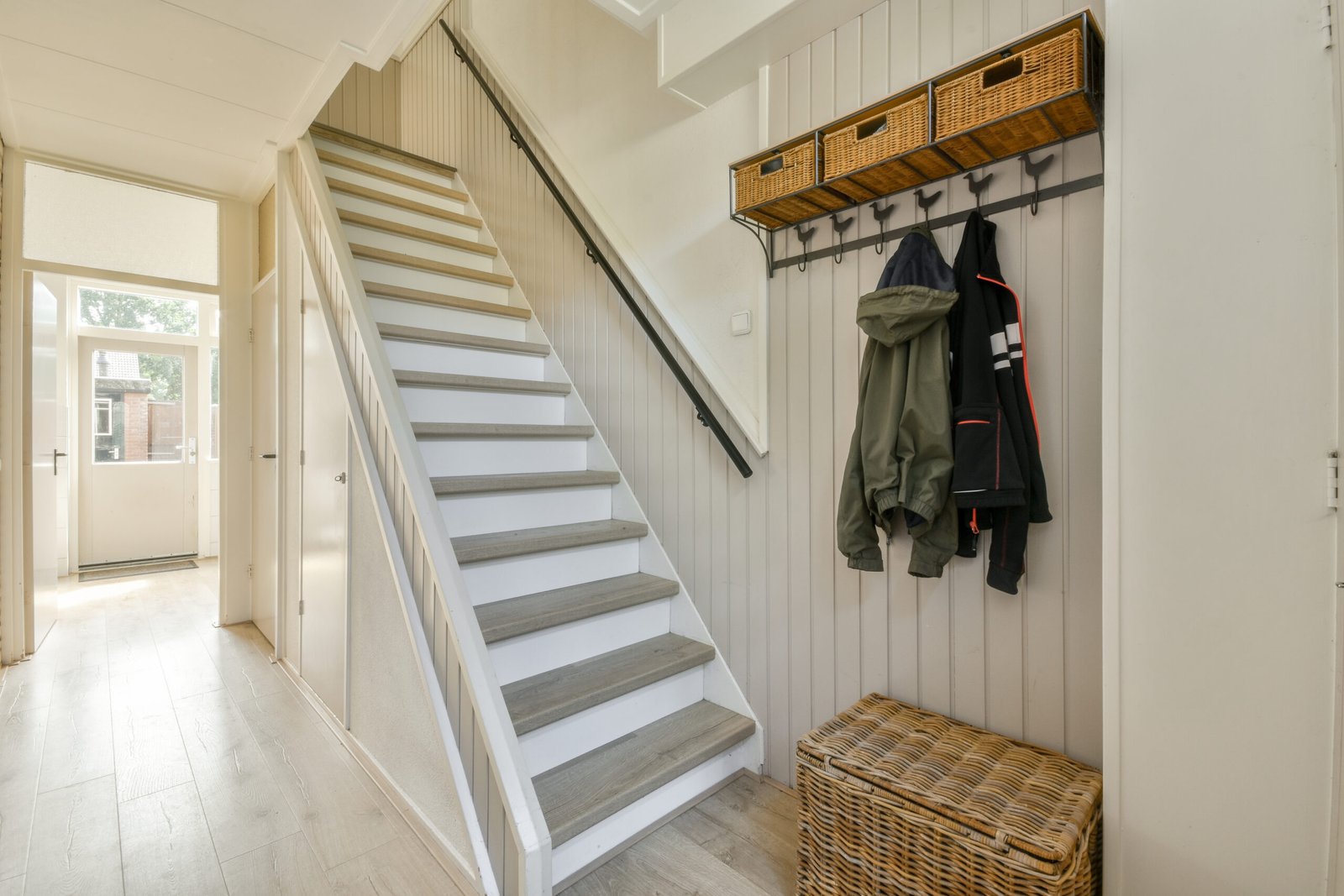
Let’s talk about entryways.
And no, I don’t mean the ones you see in architectural magazines. I don’t mean the grand, two-storey foyers with sweeping staircases, a crystal chandelier, and a marble console table that holds nothing but a vase of fresh peonies.
I mean real entryways.
The front door that opens straight into the living room carpet. The narrow hallway that feels like a tunnel, where coats pile up on a single hook until it rips out of the plaster. The corner by the door where shoes mysteriously multiply overnight like rabbits.
For most homes, the entryway isn’t a room—it’s a collision point.
It is the most high-stress square footage in your house.
- Keys land wherever your hand releases them.
- Shoes get kicked off “for now” (which turns into “forever”).
- Heavy school bags slump against the wall, tripping you up.
- Post and parcels stack up on the floor because you are “just coming back to it later.”
Because this is the first space you see when you come home, the mess hits you viscerally. You haven’t even taken your coat off, and your nervous system is already irritated. You are home, but you can’t relax yet, because you are standing in a pile of clutter.
If your entryway is especially tight, these small hallway storage ideas focus specifically on narrow layouts where every centimetre matters.
The problem isn’t that you are messy. The problem is that entryways are expected to handle too many complex transitions without any structure. Outside → Inside. Clean → Dirty. Leaving → Arriving.
Without entryway storage ideas that supports those transitions, chaos is guaranteed.
Here is how to create entryway storage that actually works—even if you don’t have a hallway, a bench, or a single spare square meter.
1. The “Bouncer” Strategy (Define the Job)
The first step to organizing an entryway is to realize what it is not.
The entryway is not a storage unit. It is not a garage. It is not a place to keep things “just in case.” It has one job: To handle arrivals and departures smoothly.
Think of your entryway storage like a nightclub bouncer. It needs to be strict about who gets in.
- VIPs (Allowed): Shoes you wear this week. The coat you are wearing today. Your keys, wallet, and daily bag. Dog leads.
- Barred Items (Not Allowed): The shoes you wear once a year for weddings. The coat that is too thin for the current weather. The box of donations you keep forgetting to drop off. Sports equipment you use on weekends only.
If an item doesn’t leave the house with you or return with you on a daily basis, it does not belong here. This single mindset shift eliminates 50% of entryway clutter immediately.
2. Shoe Control: The “Floor is Lava” Rule
Shoes are the number one reason entryways feel messy. A single pair of shoes by the door looks fine. It looks lived-in. Five pairs of shoes look like a pile. Ten pairs look like a crisis.
The mistake is letting shoes live loose on the floor. When there is no boundary, the pile expands. Better Options:
- Tip-Out Cabinets: (Like the IKEA Trones or Hemnes). These are the holy grail for narrow hallways. They are super slim (only about 7 inches deep), hide the shoes completely, and provide a shelf on top for keys.
- The Bench with Cubbies: If you have space for a bench, don’t just shove shoes underneath it. Get a bench with defined cubby holes. One pair per hole.
- The “Tray” Method: If you must leave shoes on the floor (e.g., muddy boots), use a rubber boot tray. It creates a visual boundary. “Shoes go on the tray, not on the rug.”
The Rule: Only the “Daily Rotation” lives here. As soon as you stop wearing a pair (because the season changed), move them to the bedroom wardrobe.
This rule is such a key part to any project space from hallways to garages and to organising small bedrooms.
3. Hooks Beat Rails (The Friction Factor)
Coat rails (with hangers) look tidy in photos. In real life, they fail. Why? Friction. When you come home tired, opening a cupboard, finding a hanger, putting the coat on the hanger, and closing the cupboard is too many steps. You will just throw the coat on the banister instead.
Hooks win every time.
- One Coat Per Hook: Do not layer them. If you stack three coats on one hook, the bottom one is lost forever, and the whole thing looks like a fabric tumor on the wall.
- The “High-Low” System: Install hooks at two heights.
- High Row: For adults, long coats, and tote bags.
- Low Row: For kids. If kids can’t reach the hook, they will drop their jacket on the floor. Make it easy for them to succeed.
Hooks also beat out rails when it comes to vertical bathroom storage ideas, where floor space is even more limited.
4. The “Landing Strip” (Keys, Wallet, Phone)
Every entryway needs a “Landing Strip.” This is a small, intentional surface where the items in your hands land when you walk in the door.
If you don’t have one, your keys end up on the kitchen counter, your sunglasses end up on the sofa, and your wallet ends up… who knows where.
Create a surface:
- A narrow console table (even 15cm deep is enough).
- A floating shelf.
- The top of a shoe cabinet.
The “Bowl Theory”: Do not just use a flat surface. Put a bowl or a tray on it. Psychologically, we like to put things inside other things. If you toss your keys on a table, it looks messy. If you toss your keys in a nice ceramic bowl, it looks styled.
- What goes here: Keys, wallet, lip balm, AirPods.
- What DOES NOT go here: Mail. (See point 8).
5. Bags Need Parking (Not Piling)
Bags are bulky, oddly shaped, and visually loud. If they don’t have a home, they slump against the wall and become tripping hazards.
The Parking Spots:
- Heavy Hooks: Backpacks need sturdy hooks. Do not use adhesive hooks for school bags; they will rip the paint off. Screw them into a stud.
- The Bench Top: If you have a bench, the bag sits on top, shoes go underneath.
- The Basket: For floppy tote bags or reusable shopping bags, a tall wicker basket on the floor keeps them contained but accessible.
If your entryway is essentially a corridor, these narrow hallway storage solutions prevent bottlenecks and tripping hazards.
6. The “Sit Down” Spot (Benches)
A bench is a storage workhorse. It does three things at once:
- It gives you a place to sit (so you aren’t hopping around on one leg trying to put a boot on).
- It creates a visual anchor for the space.
- It adds hidden storage.
The Best Types:
- The “Storage Chest” Bench: The seat lifts up. Use this for ugly/messy items like winter hats, scarves, dog towels, or umbrellas.
- The “Open Shelf” Bench: Good for shoes.
- The “No Hallway” Bench: If your door opens into the living room, placing a bench perpendicular to the door can create a “fake wall” that separates the entry zone from the lounge zone.
7. Vertical Storage (Selling the Air Rights)
If your entryway is basically a corridor, putting furniture on the floor will choke the walkway. You need to go Up.
- Tall Shoe Cabinets: Look for tall, thin cabinets that hold 20+ pairs of shoes but only stick out a few inches from the wall.
- Over-Door Organizers: If you have a closet door near the entry, use the back of it. Hang pockets for gloves, hats, and sunscreen.
- Mirror Storage: Use a mirror with a small shelf attached at the bottom. It checks your look and holds your keys. Mirrors also bounce light, making a cramped hallway feel double the size.
In tight layouts, applying the same principles to small bedroom storage ideas makes the entire room feel calmer and easier to use.
8. The “In-Between” Items (Dog Leads & Umbrellas)
Some items don’t clearly belong inside or outside.
- Dog leads.
- Poop bags.
- Umbrellas.
- Reusable grocery bags.
If these float loose, they become visual noise. Solution: Categorized Containment.
- Dog Station: One designated hook for the lead. One small jar for the bags.
- The “Go Bag”: Keep a tote bag hanging by the door. Put your library book returns, parcels to mail, and things to give to friends in there. It’s a “holding pen” for things leaving the house.
9. The Paper Problem (Mail Triage)
The entryway is usually where the mail enters the house. If you put it on the Landing Strip, it becomes a pile of doom.
The Recycling Bin: The best hack for a tidy entryway is a small, stylish wastepaper bin right by the door.
- Pick up mail.
- Sort immediately.
- Junk mail, flyers, and envelopes go straight into the recycling bin before they ever make it into the kitchen.
- Only the “Action” mail (bills, cards) walks further into the house.
10. The “No Entryway” Entryway
What if your front door opens directly into your living room? This is a common layout, and it’s tough. You have to manufacture an entryway.
- The Rug Trick: Place a durable runner rug or doormat perpendicular to the door. This visually defines the “dirty zone.” Shoes stay on the rug.
- The Furniture Wall: Place the back of a sofa or a low bookshelf facing the door. This creates a corridor effect.
- The Hook Rail: Even if you only have 2 feet of wall space behind the door, put hooks there. You need a drop zone, or the sofa becomes the drop zone.
Hooks are also an excellent garage storage idea – utilising wall space where available.
11. The Weekly Reset
Entryways decay quickly because they are high-traffic. It takes about three days for the shoe pile to return and the mail to stack up.
The Ritual: Sunday night is Reset Night.
- Move the “extra” shoes back to the bedroom.
- Hang the coats up properly.
- Clear the coins and receipts off the console table.
If the entryway stays 80% clear, it functions. 100% clear isn’t required.
Final Thoughts
A functional entryway doesn’t impress guests (though that’s a nice bonus). It calms you.
It absorbs the chaos of the outside world and stops it from spreading through the rest of the house. When the first five steps into your home feel organized, your shoulders drop, your breath slows, and you actually feel home.
Start with the shoes. Then get some hooks. Then clear a landing strip. You’ll feel the difference immediately.
4 thoughts on “Entryway Storage Ideas That Stop the Daily Drop-Zone Chaos”