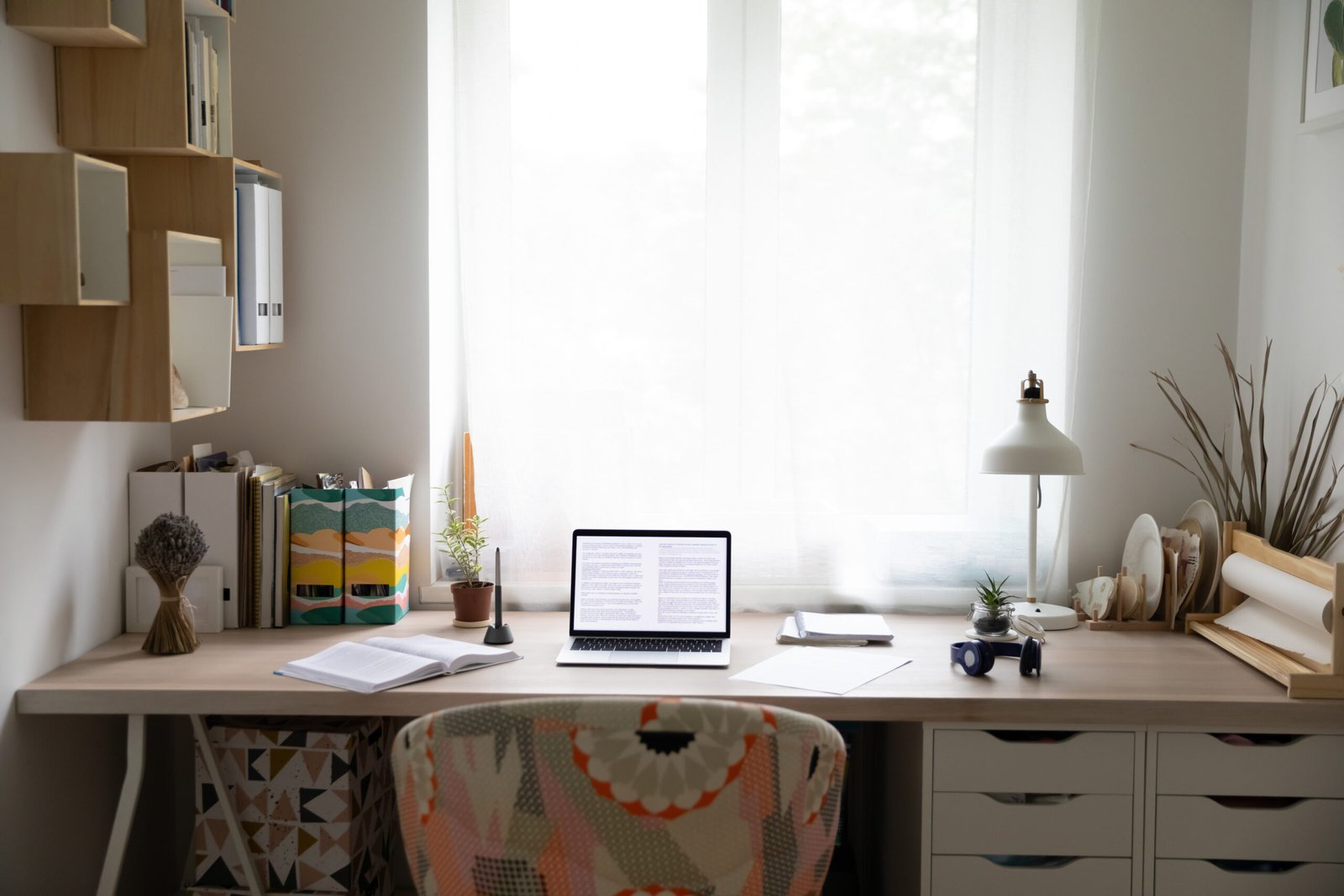
Let’s talk about desks.
Not the curated, influencer desks you see on Pinterest—the ones with a single MacBook, a ceramic mug of matcha, and a fiddle leaf fig that somehow never sheds leaves.
Let’s talk about real desks.
The ones where paperwork quietly accumulates like snowdrifts. Where charging cables breed overnight. Where “important things” sit in loose piles because you don’t quite know what to do with them yet. Where your coffee mug has to compete for space with a notebook, a pen you don’t like, a pen that doesn’t work, and a random USB stick you’re scared to throw away.
You sit down to work at 9:00 AM, and before you’ve even opened your laptop, your brain already feels busy.
That’s not a coincidence. A cluttered desk creates mental drag.
Neuroscience tells us that the human brain constantly scans the environment. Every object in your field of view competes for a slice of your visual attention, even if you aren’t consciously thinking about it. Your brain treats visible clutter like “open tabs” in a browser—it drains your battery in the background.
The problem isn’t that you’re disorganised. The problem is that most desks become accidental storage units instead of intentional “cockpits.”
Good desk organisation isn’t about having a “clear desk aesthetic.” It’s about removing the friction between you and the work. Here is how to organise your desk so it actually reduces mental clutter—without turning your workspace into a stationary shop.
1. The “Cockpit” Concept (The 40cm Rule)
In ergonomics, there is a concept called the Primary Reach Zone. This is the semi-circle of space you can reach while keeping your elbows by your sides. For the average adult, this is a radius of about 30–40cm.
The Rule: Only items used hourly belong in the Primary Reach Zone.
- Keyboard & Mouse.
- Coffee mug.
- Current notebook.
Everything else belongs in the Secondary Reach Zone (arm extended) or the Tertiary Zone (requires leaning or standing). If your stapler is sitting next to your mouse, but you only use it once a week, it is squatting in prime real estate. Move it. If you have to stand up to get a pen, the friction is too high. Map your desk by frequency, not by aesthetics.
2. Visual Noise and the Zeigarnik Effect
Psychologists speak of the Zeigarnik Effect—the tendency of the brain to remember uncompleted tasks better than completed ones. Visual clutter triggers this.
- That letter you haven’t opened? It screams “Read me!”
- That broken cable? It screams “Fix me!”
This is why a messy desk feels exhausting. To fix this, you need Containment. Ten pens loose on a desk look chaotic. Ten pens inside one opaque cup look organised. You haven’t changed the number of items; you have reduced the number of visual signals your brain has to process from ten down to one.
The Fix: Use opaque containers (solid colours) rather than clear plastic. Hiding the “visual noise” of the contents helps your brain settle.
If your desk is part of a wider setup, pairing these desk systems with smart home office storage helps reduce visual noise across the whole room.
3. Drawer Physics: Stop the Slide
An empty drawer is not organised. It is just a box waiting to fail. Most desk drawers are made of hard plastic or laminate. When you open the drawer, inertia makes everything slide to the back. When you close it, everything slides to the front. This “sloshing” creates a junk drawer.
The Material Upgrade:
- Felt or Flocking: Don’t just use plastic dividers. Line your drawers with a felt mat or use felt organisers. The friction holds items in place, and the soft material dampens the sound. A quiet drawer feels luxurious; a rattling drawer feels cheap.
- Size Matters: Standard pens are 14–15cm long. Ensure your dividers are at least 16cm long. If they are too short, the pens will end up diagonal and messy.
4. Paper: The Horizontal Trap
Paper is the silent killer of productivity. Paper is thin. It stacks easily. And when it stacks horizontally (in a pile), the bottom items disappear. We call this the “Doom Pile”—a stack of paper you avoid looking at because you know there is something scary buried in there.
The Vertical Rule: Never stack paper flat.
- Action Items: Use a “step file” or a vertical letter sorter. When paper is vertical, you can see the edges. You can see how much is there.
- Reference: Anything you need to keep but don’t need today goes into a magazine file or a binder on a shelf.
- The Trash: If you don’t need it, recycle it immediately. Do not create a “to sort later” pile. “Later” never comes.
5. Cable Management: Heat and Dust
Loose cables are not just ugly; they are dust magnets. Static electricity builds up on plastic cables, attracting dust bunnies that are hard to clean.
The Fixes:
- J-Channels (Raceways): Stick a plastic J-channel along the back edge or underside of your desk. Drop the cables into it. It keeps them off the floor and allows you to sweep underneath.
- Velcro Ties (Not Zip Ties): Never use plastic zip ties for desk cables. If you need to change a cable, you have to cut the tie (and risk cutting the wire). Use Velcro hook-and-loop ties. They are reusable and gentle on the wire.
- Don’t Coil Tightly: Safety Note: Don’t tightly coil power cables that are in use. Electricity generates heat; a tight coil can create an induction loop and overheat. Looping them loosely in a figure-eight pattern is safer.
If cables are a persistent problem, these cable organisation ideas go deeper into hiding, bundling, and routing wires safely.
6. Monitor Risers (Reclaiming the Vertical)
If your monitor sits directly on the desk, you are wasting the footprint underneath it.
The Upgrade: A Monitor Riser (Shelf).
- Ergonomics: It lifts the top of the screen to eye level (preventing “tech neck”).
- Storage: It creates a “garage” underneath. You can slide your keyboard and mouse under the shelf when you are finished working. This creates a completely clear surface for writing or reading, even on a small desk.
7. Lighting as an Organiser
You might not think of light as “storage,” but poor lighting makes clutter look worse. Shadows in corners hide mess.
The Screen Bar: Consider a monitor light bar (a light that sits on top of your screen and shines down).
- It saves desk space (no lamp base).
- It illuminates the “Active Zone” perfectly.
- It reduces screen glare.
When a workspace is well-lit, you are more likely to keep it tidy. When it is dim, it is easy to ignore the coffee cup for three days.
8. The “Neurotype” Check
Are you an “Out of Sight, Out of Mind” person? If you have ADHD or simply struggle with object permanence, putting things in opaque drawers might mean you lose them forever.
Design for your brain:
- If you need to see it: Use open wire baskets, clear acrylic trays, or pegboards on the wall. Visual organisation is valid.
- If you get overwhelmed: Use closed boxes and drawers.
- If you fidget: Don’t fight it. Have one designated “fidget bowl” with your stress ball or spinner. Don’t let five different toys clutter the workspace.
9. The End-of-Day Reset (The 2-Minute Rule)
Most messy desks don’t start messy. They end messy. You finish a Zoom call, slam the laptop shut, and run to the kitchen for dinner. You leave the mug, the papers, and the pens exactly where they are. The next morning, you return to yesterday’s stress.
The Ritual: Treat your desk like a surgeon’s table or a chef’s station.
- Take 2 minutes at 5:00 PM.
- Put the pen in the cup.
- Put the paper in the vertical file.
- Take the mug to the kitchen.
This signals to your brain that the workday is over (crucial for working from home) and gives “Tomorrow You” a fresh start.
Final Thoughts
A well-organised desk doesn’t make you smarter. But it does remove resistance.
When you sit down and everything you need is easy to find, your brain doesn’t have to warm up by fighting your environment. It can get straight to deep work. You don’t need a new desk. You don’t need more storage. You need fewer obstacles.
Start by clearing the “Primary Reach Zone.” Just that 40cm semi-circle. The mental relief will be immediate—and once you feel it, you won’t want to go back.
1 thought on “Desk Organisation Ideas That Actually Reduce Mental Clutter (Backed By Science)”