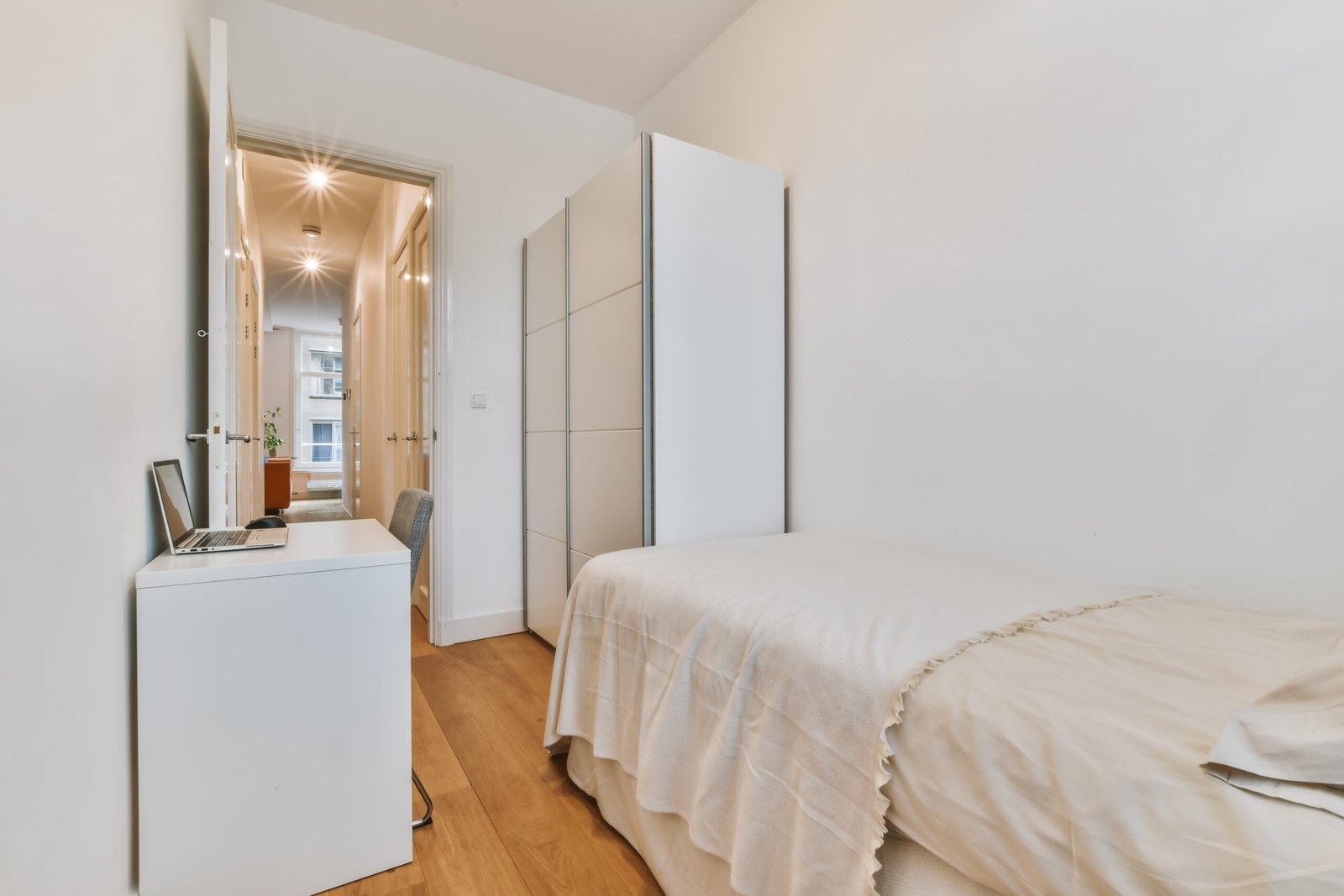
Let’s talk about box rooms.
Not the dreamy “guest suites” shown in new-build property brochures, with enough space for a king-size bed, a reading chair, and a leafy potted plant.
I mean the real UK box room. The third bedroom in a 1930s semi or a Victorian terrace that is barely wider than a single mattress. The awkward little cell at the top of the stairs that technically counts as a bedroom for valuation purposes, but realistically feels more like a walk-in cupboard with a radiator and a window.
Box rooms are one of the most misunderstood spaces in British homes. Because estate agents call them “bedrooms,” we try to force standard bedroom furniture into them. Without a strict system, the box room inevitably becomes the “Room of Doom”—a household dumping ground. Suitcases pile up. The ironing board leans in the corner. Half-used exercise equipment gathers dust. Eventually, the door stays closed permanently because opening it induces instant stress.
But a well-designed box room can be incredibly valuable. It can be a highly efficient home office, a dedicated dressing room, or a cleverly engineered kids’ room. The key is a complete mindset shift: Stop treating it like a miniature bedroom, and start treating it like a bespoke storage cabin.
Here are practical box room storage ideas that actually solve typical UK layout problems.
1. The Elephant in the Room: The Stair Bulkhead
In traditional UK three-bed semis, the box room sits directly over the staircase. This results in a massive, carpeted square box (the bulkhead) taking up a third of your floor space.
You cannot ignore the bulkhead. You have to build over it.
- The Cabin Bed Hack: If the room is for a child, hire a carpenter (or use heavy-duty MDF) to build a custom cabin bed directly on top of the bulkhead. You instantly reclaim the floor space the bed would have taken.
- The Stepped Wardrobe: If it is a storage room, build a bespoke shelving unit that steps up onto the bulkhead. Use the flat top of the box to store heavy, bulky items like suitcases or winter duvets, and use the full-height wall next to it for hanging clothes.
2. The Geometry of the Door Swing
In a room that is 2m x 2m, the door is your biggest enemy. A standard UK internal door is 762mm wide. It requires a quarter-circle of empty floor space just to open and close. In a tiny room, that door swing eats nearly 20% of your usable footprint.
The Mechanical Fixes:
- Reverse the Hinge: Have a joiner re-hang the door so it opens outwards into the hallway rather than inwards.
- The Pocket or Bi-fold Door: If reversing isn’t an option, swap the standard door for a bi-fold door or a sliding sliding barn-style door. Freeing up that 762mm arc allows you to put storage right up to the door frame.
3. Depth is Critical (The 35cm Limit)
Standard wardrobes and chest of drawers are 60cm deep. If you put a 60cm deep unit in a 200cm wide room, you feel like you are walking through a trench.
Bulky furniture instantly kills a box room. Look for slimline alternatives:
- Shallow Wardrobes: IKEA’s PAX system comes in a 35cm depth (instead of the standard 58cm). You hang clothes facing forward on a pull-out rail, rather than sideways.
- Narrow Desks: If creating a home office, a desk only needs to be 40–50cm deep to hold a laptop and a monitor stand. Keeping furniture shallow preserves the central walkway and prevents the room from feeling claustrophobic.
4. The “High-Level Wrap” (Selling the Airspace)
When you have no floor space, you must look at the 40cm of wall space sitting just below the ceiling.
The Perimeter Shelf: Install a continuous, heavy-duty shelf that wraps around two or three walls of the room, positioned about 30cm below the ceiling.
- What it does: It acts like a commercial storage rack.
- What it holds: Archive boxes of paperwork, memory boxes, off-season clothing in vacuum bags, and spare bedding. Because the storage is above your natural eye line, the room doesn’t feel crowded when you walk in, yet you have added hundreds of litres of storage capacity.
5. Pivot to a Dressing Room
One of the most effective uses for a tiny third bedroom is converting it into a dedicated dressing room. Instead of squeezing cramped wardrobes into your main bedroom (and ruining the relaxing atmosphere there), move all your clothes into the box room.
The Open-Rail Strategy:
- Do not install wardrobes with doors. In a narrow room, opening two cabinet doors at once blocks the entire space.
- Install open hanging rails and modular drawer units.
- Note: Read our wardrobe storage Ideas guide for tips on how to use uniform hangers to make open rails look neat rather than chaotic.
6. The Mid-Sleeper Bed (If it must be a bedroom)
If the box room genuinely has to function as a child’s bedroom or a guest room, a standard floor-level bed is a waste of volume.
- The Mid-Sleeper: This elevates the mattress about 70–80cm off the floor. That specific height is crucial—it provides exactly enough clearance underneath to slot in a chest of drawers, a pull-out desk, or a row of toy storage bins.
- Why not a High-Sleeper? High-sleepers (bunk height) are great, but in small UK box rooms with standard 2.4m ceilings, the person sleeping on top ends up uncomfortably close to the ceiling (and the hot air that gathers there). A mid-sleeper strikes the perfect balance.
For more layout strategies like elevated beds and slim furniture, see our small bedroom storage ideas guide.
7. Avoid Optical Chaos (Uniformity)
When you are surrounded by storage in a tight space, your brain has to process every shape, colour, and label. If you use a mix of cardboard boxes, blue plastic tubs, and woven baskets, the room suffers from visual fragmentation. It feels messy even when it is tidy.
Create a uniform facade:
- Use identical, opaque storage boxes for the shelves.
- Paint the shelving units the exact same colour as the walls so they blend into the architecture.
- When the storage looks uniform, the room feels mathematically ordered and calm.
8. Lighting as a Space Expander
Box rooms usually feature one small window and a single, dim pendant light in the centre of the ceiling. Shadows in the corners make the walls feel like they are closing in.
Layer the Light:
- Swap the single pendant for flush-mounted spotlights to push light into the corners.
- Install LED strip lighting on the underside of your shelves.
- Use Daylight bulbs (4000K) rather than warm yellow bulbs. Crisp, white light mimics natural daylight and makes restrictive spaces feel significantly more open.
9. The 80% Capacity Buffer
The most common mistake people make with box rooms is packing them floor-to-ceiling like a game of Tetris.
When every single shelf is packed, the room becomes rigid. If you buy a new suitcase or need to temporarily store a bulky parcel, there is no buffer. You end up leaving it on the floor, blocking the door. Aim to leave 20% of the shelf space empty. That breathing room allows the space to remain a functional room, rather than a sealed time capsule.
Final Thoughts
Box rooms may be small, but they are incredibly valuable pieces of real estate when engineered properly.
Instead of treating them like miniature bedrooms with traditional furniture, treat them as highly efficient, vertical storage zones. Navigate the bulkhead, fix the door swing, keep the furniture slim, and make every piece serve multiple purposes.
Because box rooms are so narrow, vertical storage ideas often make the biggest difference.
With the right structural thinking, the smallest room in the house can quietly become the engine that keeps the rest of your home tidy.
3 thoughts on “Box Room Storage Ideas (UK) That Make the Smallest Room Actually Useful”