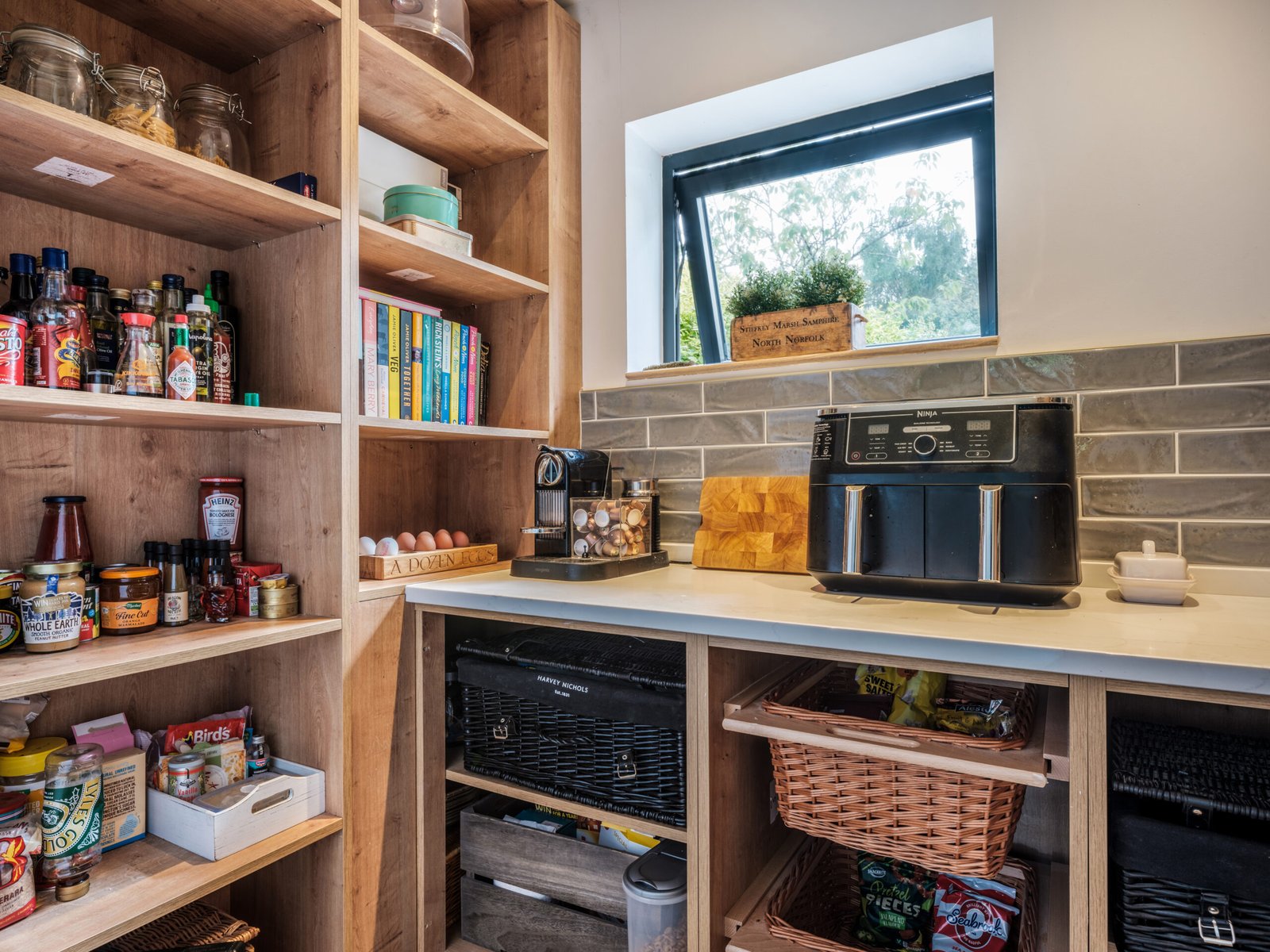
Let’s talk about pantries.
Specifically, let’s talk about what pantries actually become in most homes.
They rarely start out messy. They usually start with good intentions. You organise a few tins. You stand the pasta upright in its box. You line up the snacks like obedient soldiers. You tell yourself, “This is it. I am now an organised person.”
Then, life happens.
You come back from a big shop, tired and rushed, and you shove things wherever there is a gap. You buy a second bag of basmati rice because you couldn’t see the first one hidden behind the cereal. Snacks get stuffed behind the flour. Sauces migrate to the back corner and quietly expire.
And somewhere, deep in the shadows, there is a can of chickpeas you absolutely do not remember buying, which expired in 2022.
Pantries don’t get messy because you are lazy. They get messy because of geometry. Most pantry shelves are deep (often 40–50cm), but most food items are small (cans are only 7cm wide). When you put small things on deep shelves, you create “layers of invisibility.” Deep shelves are one of the biggest issues in small kitchen storage ideas, especially when visibility is lost.
When pantry storage fails, the cost is real. You waste food. You waste money rebuying duplicates. And cooking becomes a chore because you have to forage for ingredients like a raccoon.
The good news? Simple pantry organisation ideas are not about buying expensive matching glass jars or decanting every single grain of rice you own. They’re about Visibility and Rotation.
Here is how to organise your pantry so it actually works in real homes—even if your “pantry” is just one damp cupboard pretending to be something grander.
1. The Mindset Shift: The “Working” Pantry vs. The Bunker
The biggest mistake people make is treating their kitchen cupboard like a fallout shelter.
Your pantry is not a warehouse. It is a workspace.
If you try to store six months’ worth of food in your kitchen, you will fail. There simply isn’t enough volume.
- The Rule: Ask one question of every item: “Will I realistically cook this in the next 30–45 days?”
- The Split:
- Active Pantry: Ingredients for this month’s meals.
- Deep Storage: Bulk buys (the 10kg bag of rice, the 24-pack of paper towels). These belong in the garage, the utility room, or the top of a wardrobe.
Your kitchen shelves should support dinner tonight, not the apocalypse.
The same rules apply beyond shelves—good kitchen drawer organisation prevents overlap, hiding, and accidental duplicates in high-use spaces.
2. Categorisation: The End of “Floating” Food
Pantries fail when items don’t have clear boundaries. Loose bags are the enemy. A bag of lentils is fluid; it leans, it slumps, and it falls over. When it falls, it covers the item next to it. Suddenly, you can’t see the tomato sauce.
Fix this by categorising before you buy a single bin. Group your food by “usage,” not just food type.
- Breakfast Zone: Cereal, oats, granola, syrup, pancake mix.
- Carb Zone: Pasta, rice, noodles, couscous.
- The “Flavor” Zone: Sauces, oils, vinegars, stock cubes.
- Baking Zone: Flour, sugar, yeast, chocolate chips.
- Snack Zone: Crisps, bars, nuts.
If you can’t describe what belongs on a specific shelf in one simple sentence, your category is too vague.
These same visibility rules apply to other kitchen storage, like kitchen drawer organisation ideas, where stacking creates the same hidden-item problem.
3. The Physics of Access: Bins Beat Shelves
This is a rule of ergonomics: If you have to move three things to get to one thing, you won’t use it.
Deep shelves are “Black Holes.” The solution is to turn your shelf into a drawer.
This is the same reason corner kitchen storage ideas require movement rather than static shelving.
- The Bin Method: Place your categories into long, plastic bins that act like drawers.
- Why it works: To get the bag of lentils at the back, you pull the whole bin out. You don’t have to reach into the dark. You bring the food into the light.
- Material Matters:
- Clear Bins: Great if you are visually tidy and want to see levels.
- Opaque/Wicker: Great if visual clutter stresses you out and you want to hide the ugly packaging.
- Wire: Good for root vegetables (onions/potatoes) that need airflow to prevent rotting.
4. The “No Original Packaging” Rule (Be Selective)
Social media will tell you to decant everything. This is a trap. You do not need to put goldfish crackers in a glass jar.
However, some packaging is actively hostile to organization. When to Decant:
- Flour & Sugar: Paper bags leak. They attract moisture (which creates clumps) and pests (weevils can chew through paper). Move these to airtight, hard plastic or glass containers immediately.
- Rice & Grains: Plastic bags are slippery and don’t stack. Square containers stack perfectly (the “Tetris effect”).
- Cereal: If your kids never close the box properly and the cereal goes stale, decant it into a dispenser.
When to Keep the Box:
- Pasta: It stays fresh in the box for years.
- Canned Goods: Obviously.
- Baking Instructions: If you need the recipe on the back of the box, cut it out and tape it to the new jar, or just keep the box.
5. Reclaiming the “Air Gap” (Shelf Risers)
Most standard kitchen shelves are spaced about 30cm apart. A standard tin of beans is 11cm high. That leaves 19cm of empty air above the tin. That is lost volume.
The Fix:
- Shelf Risers: These are little metal tables that sit on your shelf. You put tins under them and tins on top of them. You instantly double your storage density without stacking cans (which is precarious).
- Under-Shelf Baskets: Slide a wire basket onto the shelf above. This is the perfect home for lightweight, flat items like tortillas, boxes of foil, or napkins.
6. The FIFO System (First In, First Out)
Expired food isn’t a discipline problem. It’s a visibility problem. Professional kitchens run on FIFO. It means you never put new stock in front of old stock.
The Habit: When you unpack groceries, do not just shove the new tin of tomatoes at the front.
- Pull the old tin forward.
- Put the new tin at the back.
- It takes 3 extra seconds.
This ensures you are always using the oldest product first, cycling through your stock naturally before it hits the “Use By” date.
7. Door Storage: The Bonus Level
If your pantry has a door, and you aren’t using the inside of it, you are leaving 10–15% of your storage space on the table.
However, be careful of weight. Standard cabinet hinges can sag if you load them with heavy glass jars.
- What goes on the door: Lightweight items. Spices, packets of seasoning, boxes of tea, aluminum foil, freezer bags.
- The Tool: Over-the-door wire racks or adhesive shallow shelves (like spice racks).
This frees up the main shelves for the heavy, bulky stuff like appliances and flour bins.
8. The “One Open Item” Rule
Why is your pantry overflowing? Usually, it’s because of duplicates. You have an open bag of brown sugar. You couldn’t find it, so you opened a new one. Now you have two open bags, both going hard.
Set a strict rule: Only one open item per product type.
- You cannot open the new cereal until the old one is empty.
- You cannot open the new peanut butter until the jar is scraped clean.
This reduces the number of “active” items on your shelves by half. It forces you to finish what you start.
9. Snack Containment (The Kid Factor)
Snacks are the fastest way to destroy a pantry. They are colorful, crinkly, oddly shaped, and they multiply. If you have kids, snacks are also high-traffic items.
The Strategy: Aggressive Containment.
- The “Yes” Bin: Create one accessible bin at a low level. Fill it with the snacks kids are allowed to take without asking.
- The “No” Bin: Put the treats you want to ration (or keep for yourself) on a high shelf in an opaque bin.
- Box Removal: Take the individual snack bags out of the big cardboard box they came in. The cardboard box takes up huge amounts of space; the bags can be compressed into a smaller bin.
10. The Monthly Inventory Reset
Pantries don’t stay organized by accident. They are high-traffic zones. Entropy sets in.
The Ritual: Once a month (maybe the day before your biggest grocery shop), spend 10 minutes on a reset.
- Check Dates: Scan the cans. Anything expiring soon? Put it on the menu for this week.
- Wipe Down: Shelves get gritty with sugar and crumbs. A quick wipe prevents pests.
- The “Orphan” Check: Find the random empty wrappers or the box with one cracker left in it. Bin them.
Final Thoughts
A well-organised pantry doesn’t have to look impressive. It doesn’t need calligraphy labels. It just needs to feel calm.
When you stop rebuying things you already own, you save money. When you can see the ingredients, you cook more creative meals. And when the pasta doesn’t fall on your head when you open the door, your evening starts on a much better note.
Start with one shelf. Maybe the spice rack. Or the cereal. Just fix one zone, and let the momentum build from there.
3 thoughts on “Pantry Organisation Ideas That Actually Stop Food From Getting Lost (and Expiring)”
Comments are closed.